





The fourth instalment of long-standing Port Vale supporter Stuart Dean’s memoirs of decades supporting the club…
This is part four and covers the managerial reigns of Roy Sproson, John McGrath and John Rudge.
75 YEARS OF SUPPORTING THE VALE - PART FOUR

By Stuart Dean
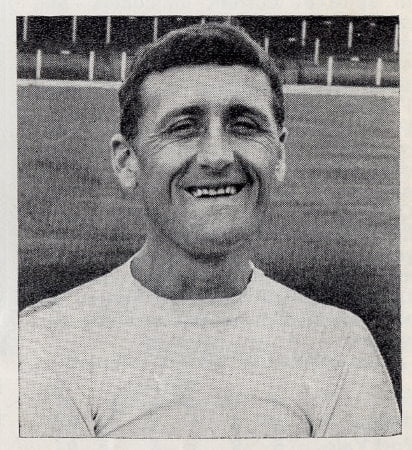
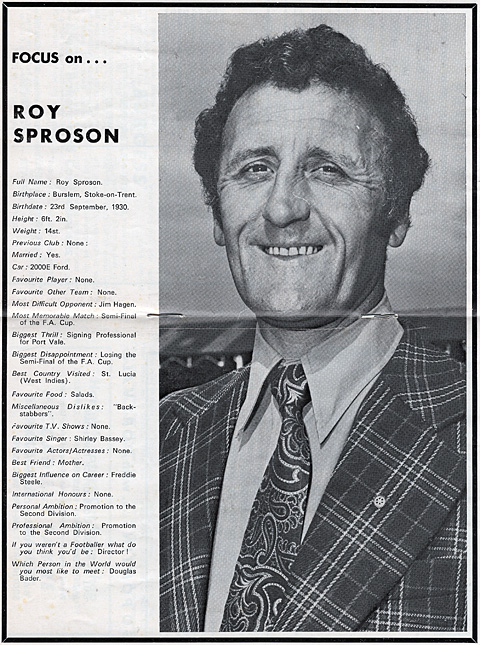
Roy Sproson took over as manager when Gordon Lee left for Blackburn Rovers. A one-club man, he holds the all-time appearance record for Vale, making 837 starts (and 5 substitute appearances) for Vale between 1950 and 1972. This includes 128 consecutive appearances between April 1954 and March 1957. Sproson stayed with Port Vale through its peak in the early 1950s and the challenging period of the late 1960s, when the club was near the bottom of the English Football League.
He played under eight different managers before becoming the manager himself from 1974 to 1977. As a relic of an era when players often spent their entire careers with a few clubs, Sproson’s appearance record for Port Vale is unlikely to be surpassed. After brother Jess introduced him to Port Vale manager Gordon Hodgson, he signed with the Vale for £3 a week while he served his National service.
In July 1949 Sproson’s time with the Royal Air Force had finished and he signed with Port Vale as a professional. However, he had to wait until 11 November 1950 for his debut, in a 1–1 draw with Gillingham at Priestfield.
Roy Sproson
Roy Sproson
After manager Gordon Lee left to join Blackburn Rovers in January 1974, he advised Vale’s chairman Mark Singer to appoint Sproson as his successor. Singer took this advice and appointed him caretaker manager before handing him the job permanently in April of the same year.
At the end of 1973–74 Vale finished twentieth, one place but seven points above the drop. He insisted that the players not call him ‘boss’, and in the spirit of Norman Low, his footballing philosophy was to go out and “entertain the public”. For the 1974–75 season he signed midfielders Terry Bailey and Frank Sharp, defender Garry Dulson, and goalkeeper John Connaughton. The club finished in sixth place, just four points short of promotion.
However, due to the club’s precarious financial situation a total of 13 players were released. He made ambitious plans for the 1975–76 season. However, he failed to land Welsh internationals Mike England and Wyn Davies. Instead he signed striker Mick Cullerton from Stafford Rangers for £4,000, and midfielders Terry Lees (a £3,000 signing from Stoke City) and Geoff Morris (a £200 signing from Bangor City). Cullerton hit 21 goals. Still, Vale could not repeat their efforts of the previous season and had to make do with a twelfth-place finish.
For the 1976–77 season, he was forced to sell Terry Lees to Sparta Rotterdam for £25,000 (representing a £22,000 profit in the space of twelve months). He added to his squad with youngsters Ian Osborne and Kevin Kennerley and experienced midfielder Geoff Davies. After Cullerton suffered a cartilage injury, he signed Ken Beamish for a £12,000 fee from Blackburn Rovers, as well as former Wigan Athletic forward John Rogers for “a small fee”.
His team struggled with poor discipline – Rotherham manager Jimmy McGuigan claimed Vale were “the worst exhibition of football thuggery I have ever seen”. Midway through the season Sproson sold two more key players: striker Ray Williams went into non-League football for a small fee and midfielder Colin Tartt joined Chesterfield for £15,000. Sproson brought in Alan Lamb from Preston North End and Peter Sutcliffe from Stockport County for a combined outlay of £8,000. Ultimately, though, the loss of star midfielder Brian Horton to Brighton for £30,000 in March 1976 was something Sproson proved unable to remedy. Nevertheless, relegation was narrowly avoided at the end of 1976–77, as his side finished 19th, three points above the drop.
There was unrest at Port Vale at the start of 1977–78, as Sammy Morgan and David Harris were so upset by the low wages they were offered that they refused to play for the club. Sproson brought in three players on free transfers: Jeff Hemmerman, Grahame McGifford, and Bill Bentley. However, at a meeting on 28 June, Sproson was severely criticised for his supposed poor judgement of players and for seeming to place greater priority on his newsagent business than the club.
The Sentinel reported that “there is disenchantment in the air”, and there were rumours that former Stoke manager Tony Waddington would be brought in to replace Sproson. Sproson was sacked in October 1977 after a poor run of results. His replacement Bobby Smith failed to rescue Vale from relegation despite making numerous signings. Sproson refused the club’s offer of “an executive position dealing with the club’s youth policy”. It was clear his sacking had upset him greatly. Leaving under a cloud, he refused to return to the club whilst those who had sacked him remained in the boardroom.
Port Vale’s away kit for the 2005–06 season (in the club’s old amber and black colours) bore the motto “837 – One Man One Team” embroidered on the left sleeve to honour his memory. A street by Vale Park has been named Roy Sproson Way in his memory. In March 2011, he was inducted into the City of Stoke-on-Trent Hall of Fame, along with Gordon Banks.
After ten years of planning, a £96,000 statue of Sproson was unveiled on 17 November 2012, before a home game with York City. In May 2019, he was named in the “Ultimate Port Vale XI” by the onevalefan supporter website. His was one of four faces on a community mural unveiled at Vale Park in December 2025, alongside John Rudge, Robbie Earle and Tom Pope.
The 2005 home kit

The community mural at the Vale Park stadium
This inspired me to produce a one-off mug, which was donated to the Ale & Vale Podcast to raise funds for the Port Vale Foundation at one of their recent quiz nights.

Stuart Dean's community mug design

Rob Fielding
At this point I’d like to give onevalefan founder, Rob Fielding a mention. Founded in 1996 by Rob Fielding, award-winning onevalefan is now the busiest Port Vale FC site in the world. It was originally called “There’s only one Vale fan in Bristol?” in a plea for fellow exiles to get in touch. When Rob left Bristol, he decided to keep just the “onevalefan” part of the name.
The site was voted the “fans site of the year” in 2000 by the Footy 51 fanzine, came second in the football-shirts.co.uk nationwide fans awards for 2005 and won site of the year in the 2014 Six Towns Radio awards. The onevalefan site is editorially independent of Port Vale FC.
OVF supported the Help for Heroes campaign and arranged a surprise treat for two Port Vale fans who had returned from duty in Afghanistan and were made guests of honour for a game in 2013. The site supports the work of many Port Vale organisations including Valiants Against Racism and have supported the funding of the statue of Roy Sproson.
OVF have also sponsored three Lorne Street suites (in honour of Vale legends Darren Hughes, Dickie Cunliffe and Andy Jones). In essence, OVF has shown a moral duty to represent the best interests of Port Vale fans and in the past backed protest groups seeking a new board in charge of the club.
In 2013, Rob wrote his first book “No Ordinary Season” about that season’s astonishing promotion. OVF has also produced mugs, mousemats and posters – many of which have raised money for its two chosen charities – the Donna Louise Trust and the Douglas Macmillan Hospice.
My all time favourite Port Vale event is the Vale Vaults exhibition curated by Rob in 2014 and so generously hosted by the wonderfully hospitable Amanda and Paula at the Barewall Galleries in Burslem – the first-ever fans-operated free exhibition of Port Vale memorabilia.
Vale fans would be immeasurably worse off without onevalefan
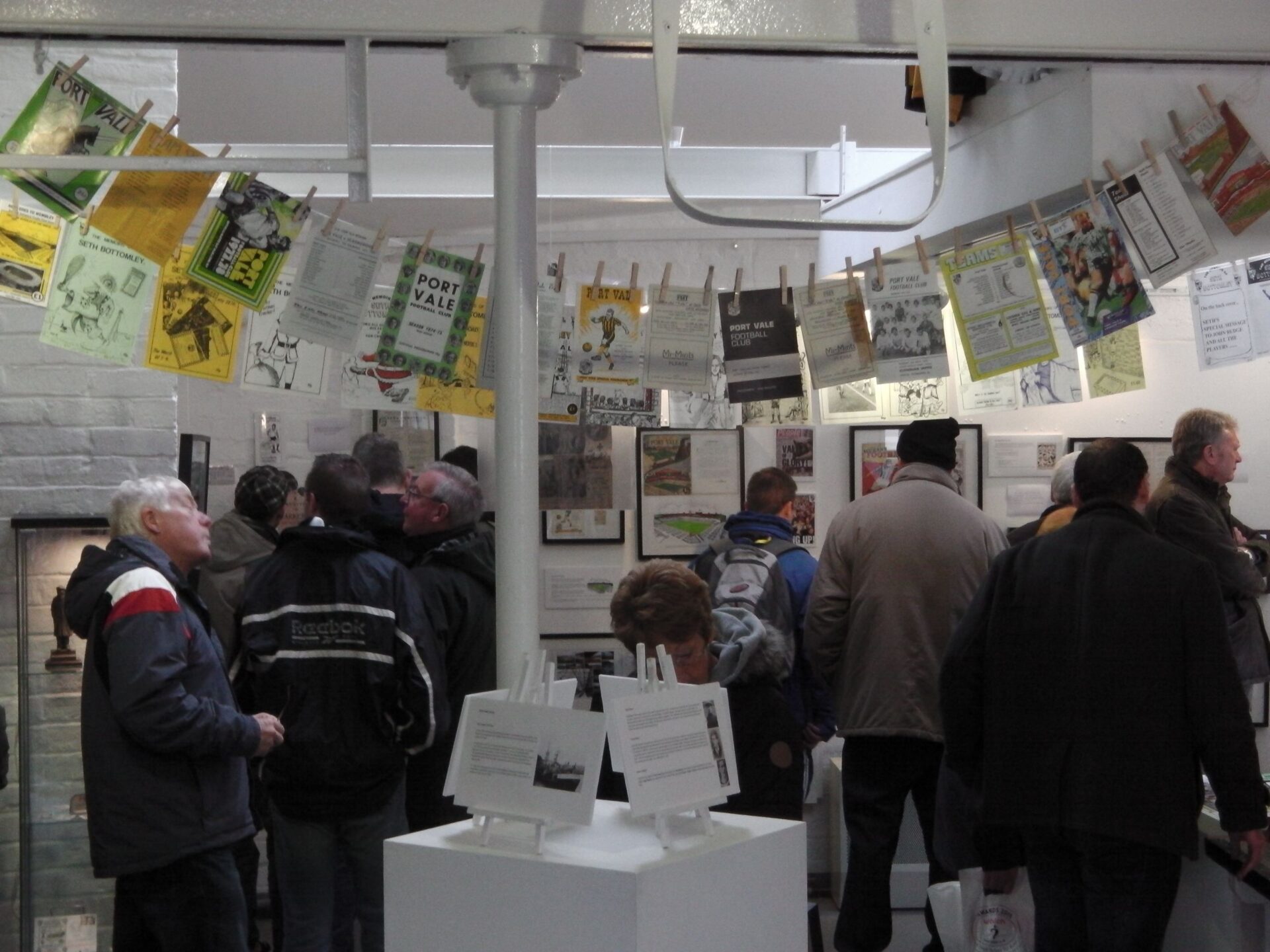
Vale Vaults
John McGrath
Following Sproson’s dismissal, Bobby Smith was appointed as manager and, despite overseeing a relegation at the Vale, was hired as Swindon Town’s new boss in May 1978. His assistant, Dennis Butler, stepped up to the head role at the Vale and spent big on transfers with very little success. Butler left by mutual consent in August 1979 and Stoke City legend Alan Bloor took the reins, only to resign four months later after finding that management was not for him.
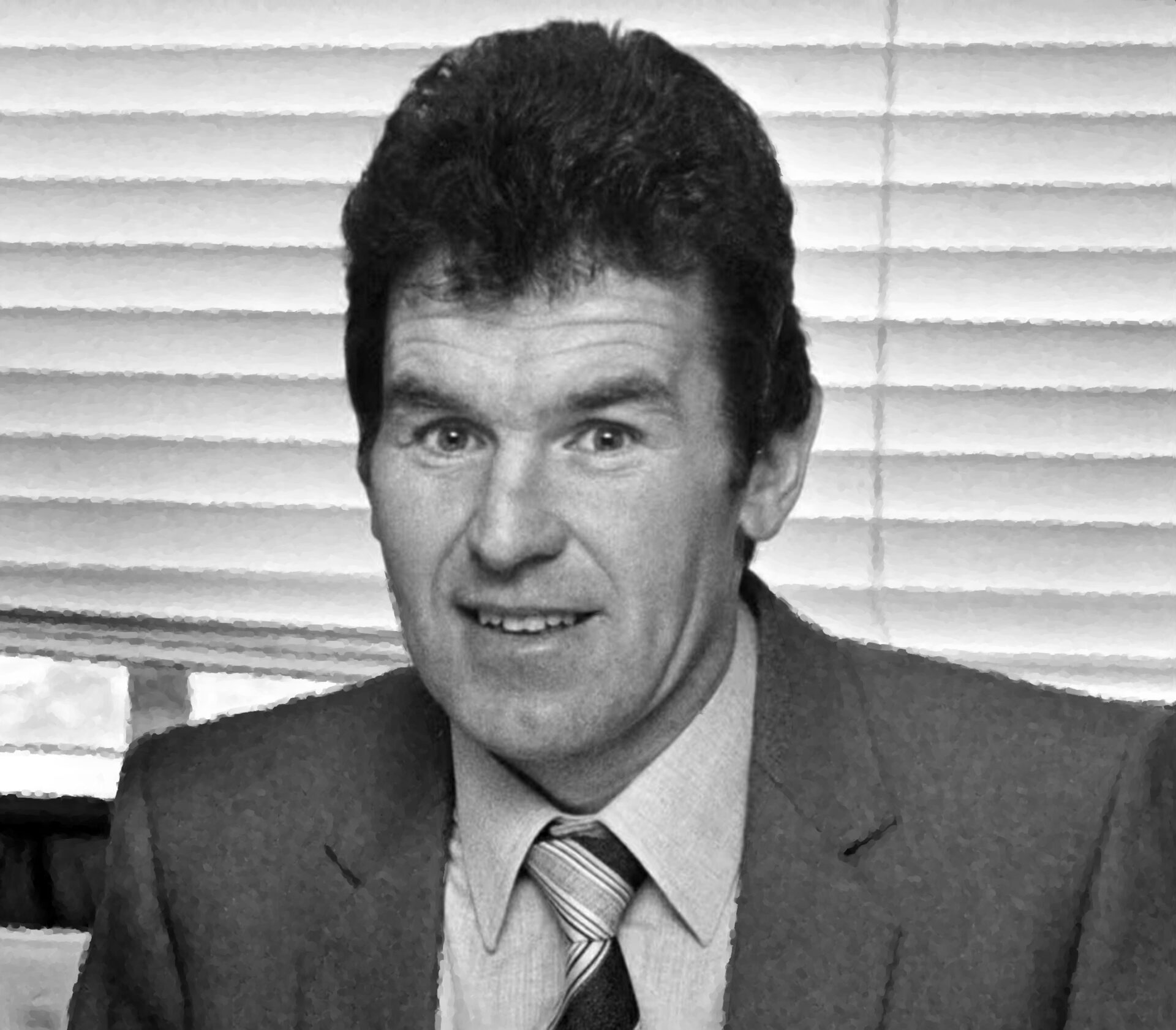
With the club at a low ebb, John McGrath got his break in management when he was appointed Port Vale manager in December 1979. A man of discipline, he levied two fines within his first fortnight with the club. He demanded dedication and effort from his players. He managed to steady the ship following brief and unsuccessful reigns from rookie managers Dennis Butler and Alan Bloor, stating that “the holiday is over”.
The Vale finished fifth-from-bottom in the Fourth Division in 1979–80, outside of the re-election zone on goals scored. He appointed John Rudge as his assistant. McGrath offloaded many under-performing players, transfer-listing 15 of them, and signed goalkeeper Mark Harrison and defender Lee Harwood from Southampton. McGrath spent the 1980–81 season attempting to whip his charges into shape, whilst Vale fans patiently awaited the true results of a manager they quickly built faith in. The only new signings he could afford to make were free signings John Allen from Leicester City and Trevor Brissett from Stoke City. Vale exited the FA Cup at the third round following a humiliating 3–0 defeat to non-League side Enfield. They initially struggled away from home. Still, they built their league campaign on results at Vale Park. During the season, he handed Mark Chamberlain (younger brother of top-scorer Neville) his debut and brought in talented winger Johnny Miller.
Speedy winger and local lad, Mark Chamberlain, started his Vale career as a substitute in a home game against Scunthorpe in August 1978, aged just 16. His full debut came later that season in April 1979 and he signed his first professional contract the following month. He became a first team regular for John McGrath in the 1980/81 campaign, scoring 10 goals in the process. He was then an ever present in 1981/82, playing 55 games, scoring 9 goals and was included in the PFA League Four team of the season.
Mark was sold to Stoke City in August 1982 in a combined deal with Vale goalkeeper Mark Harrison which was worth £180,000. Already an England U21 international by that stage, Mark broke into the England senior team during his first season at Stoke and scored on his debut for the national team against Luxembourg at Wembley. He went on to play a further 7 times for England during his time at Stoke and also played for Sheffield Wednesday, Portsmouth and Brighton before finishing his playing career at Exeter.
At the mid-way stage McGrath brought in midfielder Terry Armstrong and big defender Andy Higgins. He solved the team’s poor away form by installing a five-man defence. He built for the 1981–82 season by signing defender Ray Deakin from Everton; midfielder Geoff Hunter from Crewe Alexandra for £12,000; and forwards Ernie Moss from Chesterfield for £12,000 and Jimmy Greenhoff from the Toronto Blizzard. They lost just one of their opening eight games, before their form suffered due to an injury crisis. In mid-season, Vale went 15 games unbeaten before another bout of injuries caused their promotion campaign to wither into a seventh-place finish. Having drawn 12 home games, McGrath said, “we blew it at Burslem”. He did though manage to blood young striker Mark Bright and the following season handed Robbie Earle his debut, both of whom would become top-flight footballers.
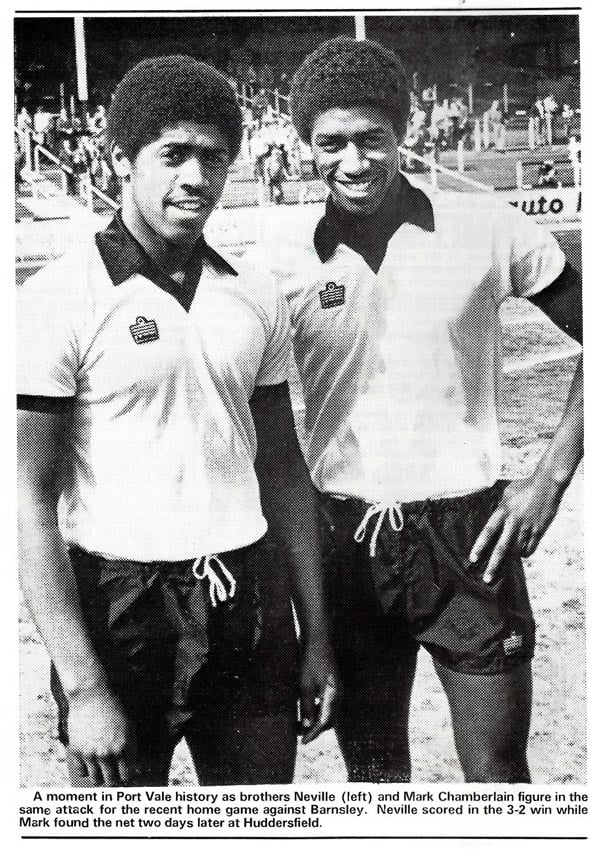
The Chamberlain brothers
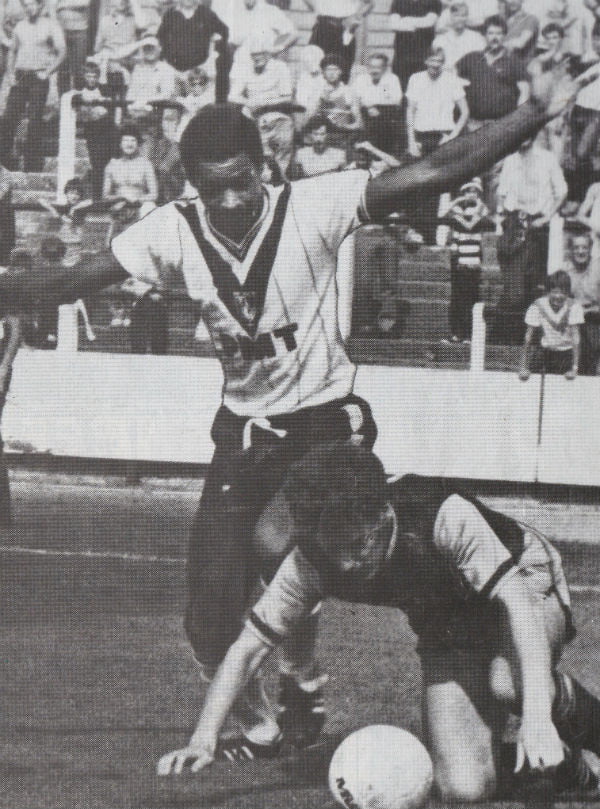
Mark Bright
Locally born striker Mark Bright spent a year as a youth team player at the Vale before being released at the age of 16. He then played part-time football at Leek Town and for Sunday League side Mason’s Arms, before he rejoined Port Vale as an amateur in October 1981 on the recommendation of Vale player Russell Bromage. Vale Manager John McGrath handed Mark his full debut on the last day of the 1981/82 season and he went on to sign an initial one-year part-time contract while also working as an apprentice for Staffs Hydraulics. He played just once in the Vale’s 1982/83 promotion winning season and then rejected an initial full-time professional contract offer as it paid less than his factory job, though he ultimately signed a revised offer which included appearances and goal bonuses.
Mark improved his game considerably under the guidance of new boss John Rudge during the 1983/84 season, scoring ten goals in 31 games although this did not prevent the Vale from being relegated from the Third Division. Mark was offered a new two year contract which he did not accept and he was consequently sold to Leicester City for £33,333 in June 1984. This fee was later doubled due to a top-up clause. Mark went on to play for Crystal Palace, Sheffield Wednesday and Charlton Athletic, most of which was in the top flight and he scored a career total of 212 goals.
He has worked as football correspondent on Radio and TV and is currently the head of under-23’s development at Crystal Palace. Mark was inducted into the Stoke-on-Trent Sporting Hall of Fame in 2019.
Promotion was eventually achieved with a third-place finish in 1982–83. This was despite McGrath selling Mark Chamberlain and Mark Harrison to Stoke for £100,000. He made five free signings: John Ridley (a former Valiant), Wayne Cegielski (Wrexham), Les Lawrence (Torquay United), Steve Waddington (Walsall), and Barry Siddall (Sunderland).
He further sold Neville Chamberlain to Stoke for £40,000, bringing in burly striker Bob Newton from Hartlepool United for £15,000. Vale went top of the table despite a goalkeeping crisis which saw Barry Siddall, Neville Southall, Neil McAdam, and Andy Poole between the sticks at different points in the campaign. He bought striker Jim Steel from Oldham Athletic for £10,000, whilst letting Ernie Moss go to Lincoln City for a £1,500 fee after judging him to be too old to be of any further use. With 34 goals conceded, Vale had the best defensive record in the Football League.
Another critical signing that season was Steve Fox who joined on a free from Wrexham. Steve was a fast tricky winger, whose goals and assists played a vital part in achieving promotion. I remember a trip in April 1983 to Prenton Park when goals from Newton and Fox secured a 2 – 0 victory over Tranmere Rovers to almost guarantee promotion.
A group of elderly Vale fans were attacked just before kick-off in the main stand when their allegiance was revealed as they applauded the Vale team onto the pitch. I also met John Taylor (a teacher from Audley who was a great supporter of the Bignall End cricket club and was responsible for introducing a young Bob Taylor to the club) and if I recall our conversation correctly, he was acting as the EFL assessor at the game.
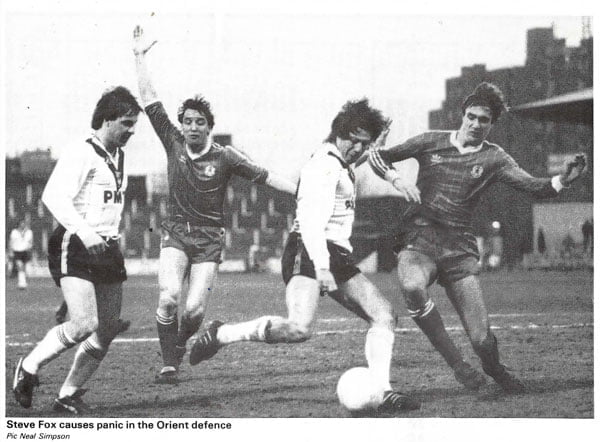
Steve Fox
The following season, however, McGrath conflicted with chairman Jim Lloyd, who instructed him to speak to the press only on team matters; numerous players also were disgruntled over contract issues.
By December 1983, Vale were three points adrift at the foot of the Third Division and McGrath was sacked. McGrath had made some poor choices during his final months at the club, signing Ireland international striker Eamonn O’Keefe from Wigan Athletic for £10,000 only to play him in midfield, and allowing player unrest to fester as several rejected new contracts and four stayed at the club on weekly contracts – this was despite Vale paying the third-highest wage bill in the division (£9,000 a week).
He also offloaded top-scorer Bob Newton to Chesterfield in exchange for Martin Henderson, who was not a success. Much travelled striker Bob Newton joined the Vale from Hartlepool for a fee of £15,000 at the beginning of the 1982-83 season. He was a big strong old school centre forward who formed a dynamic partnership with fellow striker Ernie Moss and went on to score 22 goals in 42 appearances that season as Vale gained promotion from Division 4.
John McGrath nicknamed Newton and strike partner Ernie Moss as the “Kray Twins” due to their dominance of opposition defenders. He became a fans favourite for his no-nonsense, robust style of play but sadly his time at the Vale was cut short in October the following season when he decided to join hometown club Chesterfield. Former team mate Robbie Earle commented on Bob Newton in his Sentinel column in 2012 –
We were quite a big, physical team and, in Bob Newton, had this barrel-chested striker who just loved a battle with the opposition centre-halves. I hope he doesn’t mind me saying that his game was less about finesse and more about bundling the ball into the net – taking the goalkeeper with it if necessary.
Don’t get me wrong, Bob was a good player, as his 24 goals in 51 appearances suggests. Besides, I had reason to be grateful for his fearsome reputation. When I broke into the team as a naive teenager, any defender who tried to kick lumps out of me would soon get a warning from Bob.
He was a cult hero with supporters who loved to see him score goals, and bully defenders. He would sometimes take his false front tooth out to make him look more ferocious. There was nothing underhand or sneaky about his game. All the crowd could see when he was going to put a full-back into the Railway Stand…
Bob didn’t join the Vale without baggage. Following a car accident in 1978 in which his passenger, Hartlepool teammate Dave Wiggett, was fatally injured; he was sentenced to nine months in prison after being found guilty of causing death by reckless driving. A couple of years ago I was in conversation with a member of the judiciary whose first job had been to represent Bob at his trial. He recalled that Bob was overwhelmed by remorse and had witnessed a grown man crying when he had entered the cell to brief Bob.
McGrath retained the support of the fans, who criticised the board for their decision to sack him. During his time at Vale Park, he made some unorthodox decisions, such as putting 15 players on the transfer list at once, taking the team for a swim at Blackpool, and one time sending assistant manager John Rudge hundreds of miles on a scouting mission, only to rip up the report in the dressing room, declaring to his players that “It’s not about them, it’s about us.”.
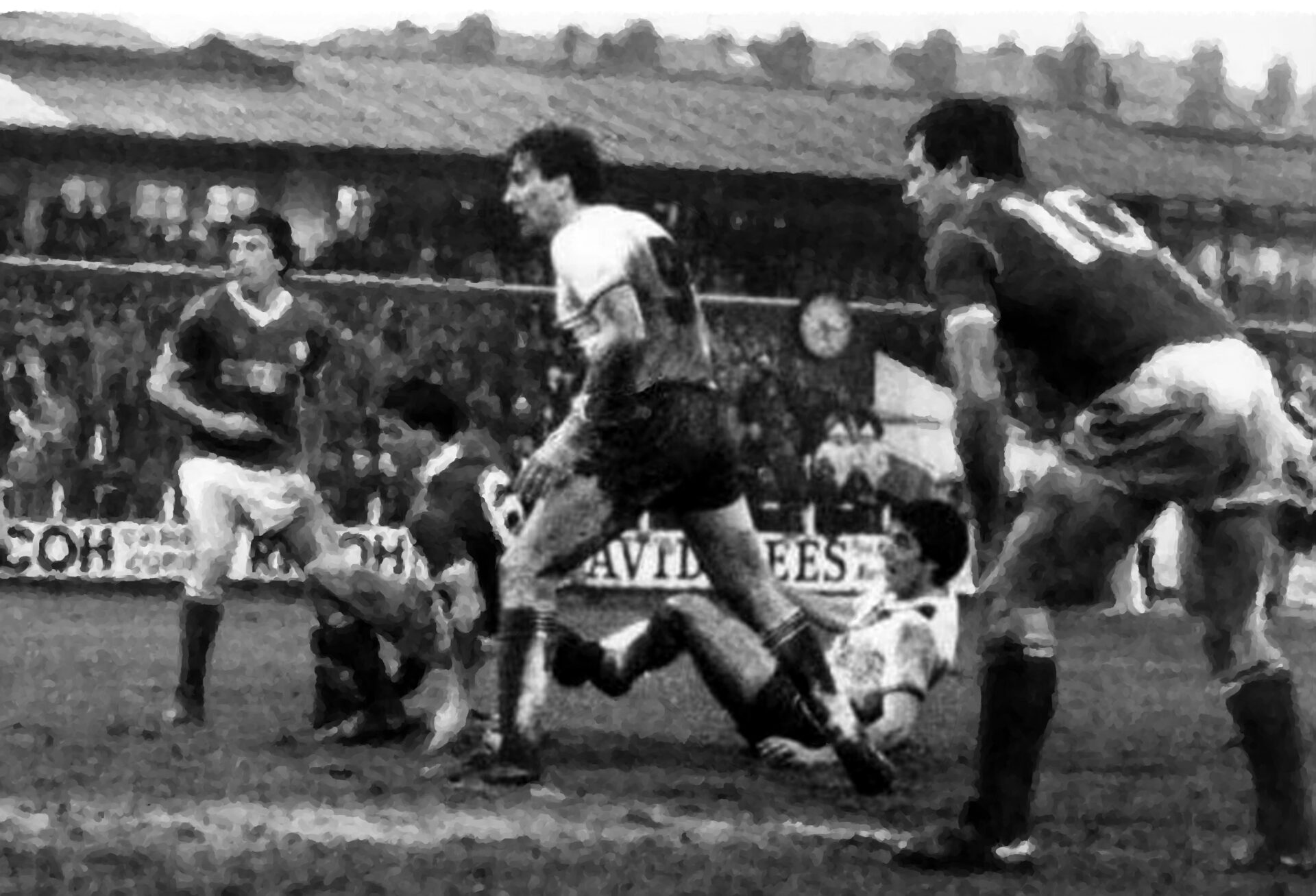
Bob Newton with strike partner Ernie Moss
Read all the episodes
- 75 years a Vale fan: part one of Stuart Dean’s Port Vale memoirs
- 75 years a Vale fan: part two of Stuart Dean’s Port Vale memoirs
- 75 years a Vale fan: part three of Stuart Dean’s Port Vale memoirs
- 75 years a Vale fan: part four of Stuart Dean’s Port Vale memoirs
- 75 years a Vale fan: part five of Stuart Dean’s Port Vale memoirs
- 75 years a Vale fan: part six of Stuart Dean’s Port Vale memoirs
- 75 years a Vale fan: part seven of Stuart Dean’s Port Vale memoirs
Share your thoughts on these memories and post a comment below


This comment is not directly related to this article but it is related to the production of the articles. As you may gather, I’ve created a template and then I create each feature by duplicating the previous piece and editing it. The previous piece mentioned Vale’s expulsion from the League with an image captioned “the lowest point in the club’s history”.
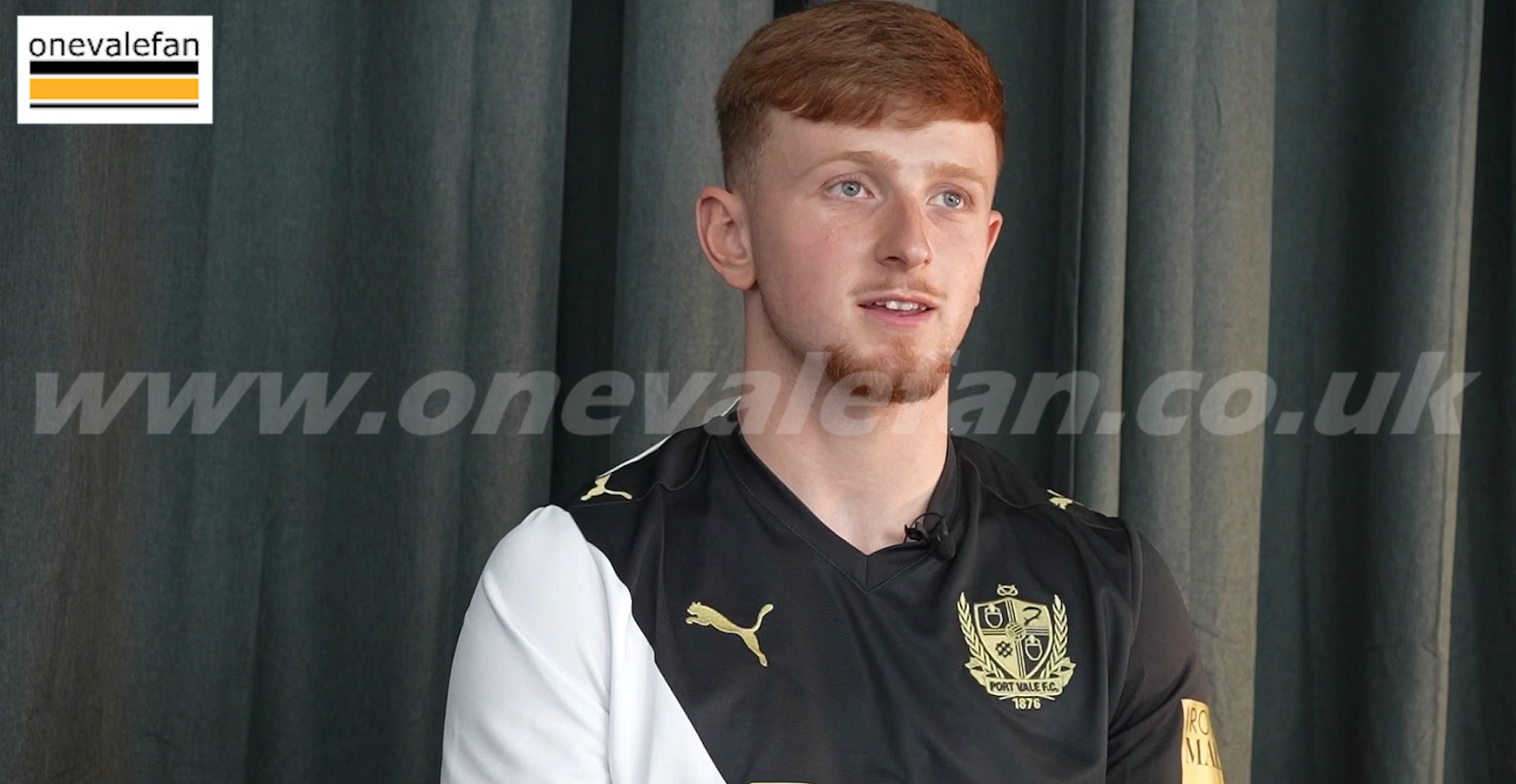
When I duplicated the previous piece and started to replace the text and the images, I initially forgot to replace one of the captions. The caption “the lowest point in the club’s history” was underneath the photo of myself. Some of you may well agree with that assessment…
Stuart -you mention meeting John Taylor at Tranmere. John was my father. He wasn’t an EFL assessor but most likely was attending the game with his friend Bob Speake from Audley who was an assessor. They attended many games together.
Thanks for the feedback. It’s nice to know that one’s memory is partially correct and that senility hasn’t completely set in. I have the greatest of respect for your father. When I played cricket at Bignall End in the Kidsgrove League he was so supportive and full of great advice when things weren’t going as well as they might. A tower of strength always there in the background when needed.
Thank you Stuart.
Once again, so interesting to look back on. Common theme mentioned in that period was Vale’s low wages. Hardly surprising really because home league gates rarely averaged more than 4,300, and one season even slipped to 2,700. Hope those days don’t return.