





The seventh instalment of long-standing Port Vale supporter Stuart Dean’s memoirs of decades supporting the club…
This is part seven and continues to reflect on the John Rudge glory years.
75 YEARS OF SUPPORTING THE VALE - PART SEVEN

By Stuart Dean
In 1991–92, the club finished in last place, five points shy of safety. Vale were still a Second Division club due to the creation of the Premier League, though they were now in the third tier. Vale had gone 18 games without a win in the campaign’s second half after Ray Walker was sidelined for five months with ligament damage – Nico Jalink proving to be an inadequate replacement.
Ian Taylor became another excellent signing after he was purchased from non-League Moor Green for £15,000 in May 1992. A midfielder, he had a 15-year career in the Football League and Premier League, scoring 103 goals in 577 league and cup competitions. Before this, he had scored 67 goals in 235 matches playing non-league football with Moor Green. Port Vale manager John Rudge saw him as a potential replacement for Robbie Earle. His debut came on 7 August 1992, in a 5–0 win over De Graafschap in the TNT Tournament. He became a regular in the side and in 1992–93 scored 19 goals to become the club’s top scorer and earn himself the Player of the Year award, as well as a place on the PFA Second Division team. He was once again selected in the PFA’s divisional team of the season for the 1993–94 season. He also lifted the Football League Trophy, scoring a “stunning overhead back heel” against Fulham in the opening round, and going on to play in the final as Vale beat Stockport County 2–1 at Wembley Stadium. He returned to Wembley for the Second Division play-off final, which ended in a 3–0 defeat to West Bromwich Albion.
He would later state: “John Rudge gave me the opportunity to play professional football. He put me in the team and had faith in me. That was the bedrock of my career”. He made a million-pound move to Sheffield Wednesday in June 1994, and he was sold on for two million to Aston Villa later in the year.
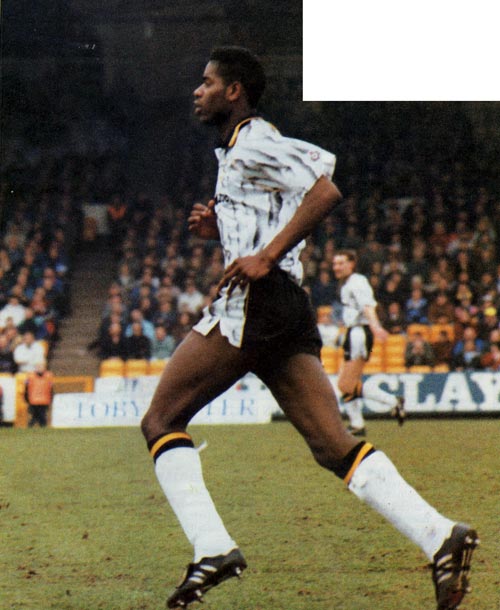
Ian Taylor
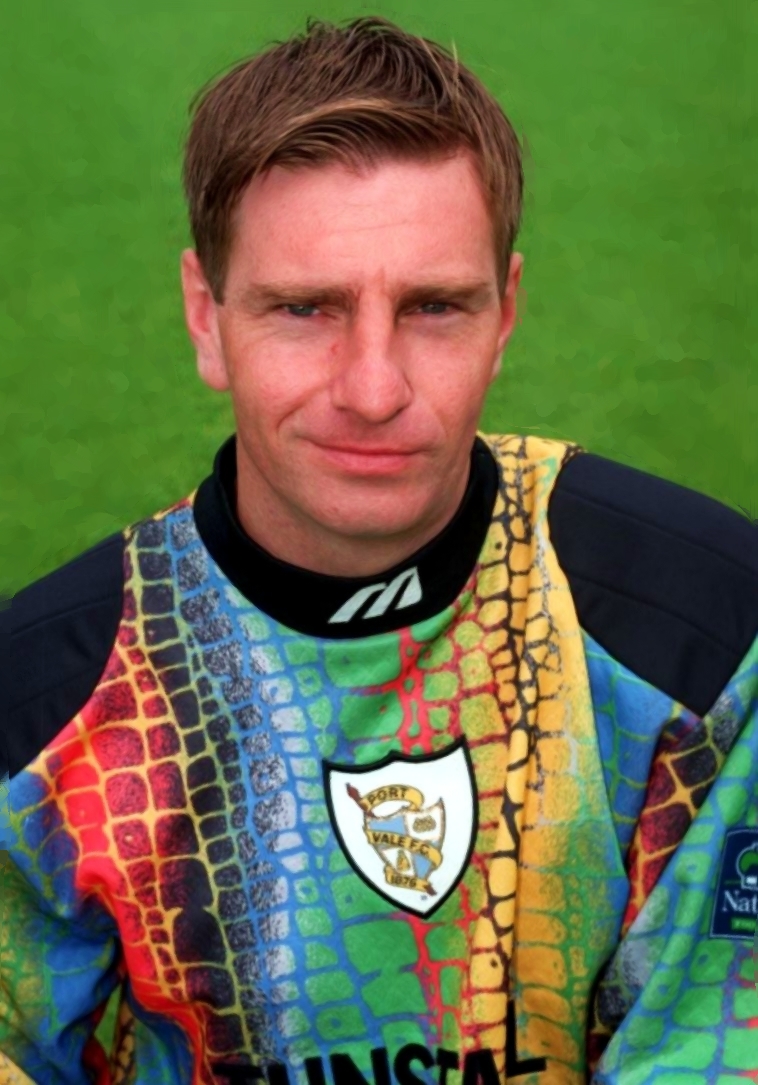
Paul Mussselwhite
Another key arrival for the 1992–93 campaign was goalkeeper Paul Musselwhite, signed for a £17,500 fee from Scunthorpe United to take the place of the ageing Mark Grew, with Musselwhite going on to feature in over 360 games over the next eight years. Musselwhite began his career with Portsmouth before joining Scunthorpe United in March 1988. He played 132 league matches for United, as Scunthorpe suffered numerous play-off defeats before he was sold to Port Vale in July 1992.
He spent the next eight years with Vale and played 312 league matches in what was one of the most successful periods in the club’s history. Musselwhite started 1992–93 as second-choice behind Trevor Wood. However, on 5 September 1992, Wood conceded a penalty at Vetch Field in an ‘off the ball’ incident with a Swansea City player and was subsequently dropped in favour of Musselwhite. He made his Vale league debut in the next match, a 2–2 draw against Exeter City on 12 September 1992. Despite a nervy performance, he remained an ever-present in the team for the rest of the season.
On 24 October, he gave away a penalty kick in a 2–1 defeat at Potteries derby rivals Stoke City, though claimed, quite rightly, that Mark Stein had dived. The Memoirs of Seth Bottomley recorded the dive with the cartoon included in the bottom left corner of the penalty photograph.
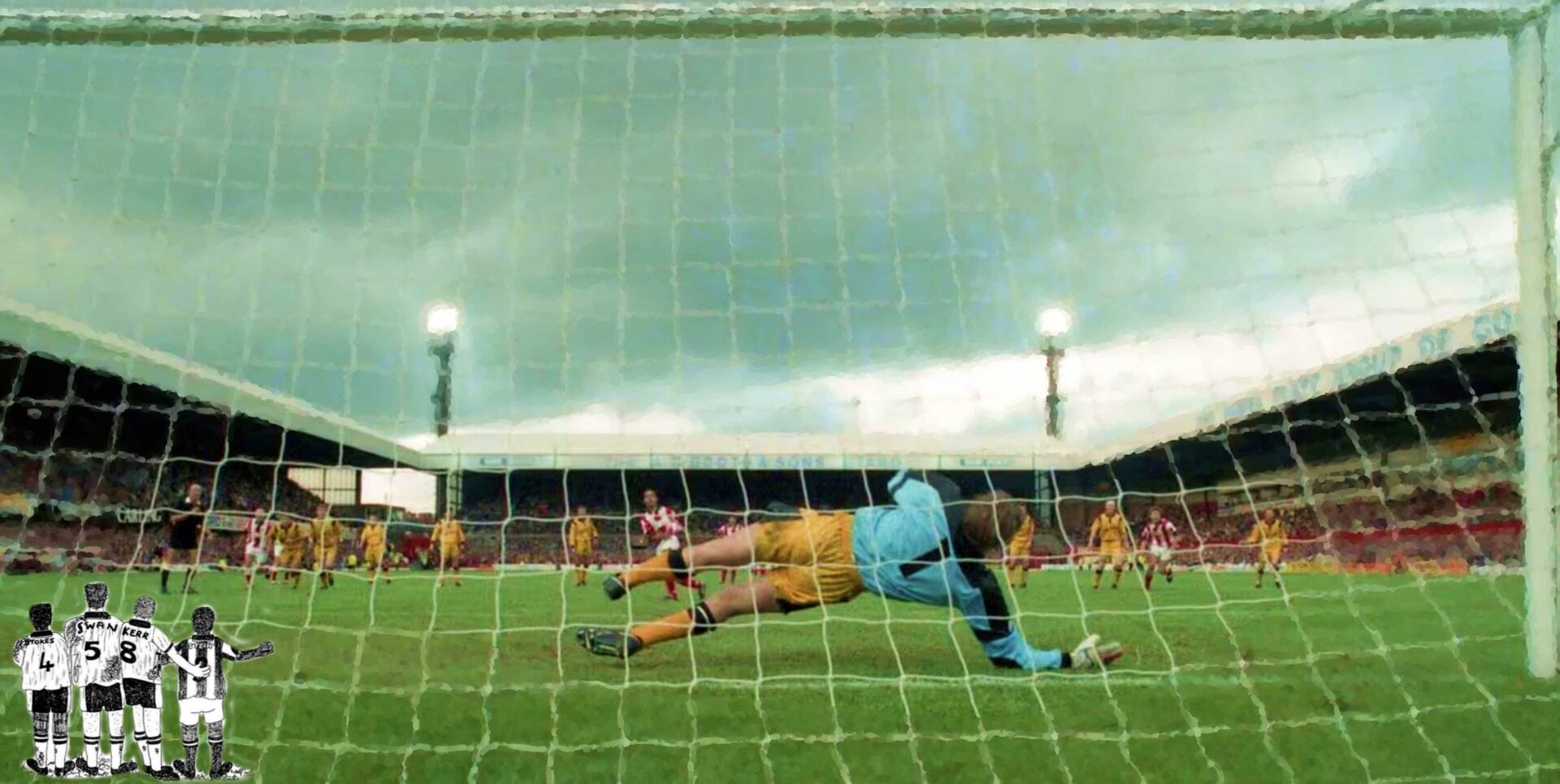
That penalty and how Seth saw it
Vale finished the season one point behind Bolton in third place, and they lost in the play-off final 3–0 to West Bromwich Albion. Musselwhite did have success at Wembley Stadium in the 1993 Football League Trophy final, with Vale recording a 2–1 victory over Stockport County and also winning promotion to the First Division in 1993–94, finishing in second place behind champions Reading. Both club and goalkeeper adapted well to the second tier, finishing 10 points above the relegation zone in 1994–95.
The Vale finished in 12th place in 1995–96 and were awarded the ‘Giantkillers of the Season’ award for knocking Everton out of the FA Cup in the fourth round. Musselwhite played in the 1996 Anglo-Italian Cup final, as Vale lost 5–2 to Genoa. The club achieved their highest post-war position in 1996–97 – eighth in the second tier. Musselwhite made 36 appearances that season, after missing out on the first six weeks. He made 45 appearances in 1997–98, keeping a clean sheet against Arsenal in the FA Cup on 3 January 1998. He made 40 appearances in 1998–99, missing most of November and all of December. In 1999–2000, Vale were relegated in 23rd place, with manager Brian Horton unable to halt the decline at Vale Park. Musselwhite battled with Kevin Pilkington for a first-team place and played 32 matches.
He was sent off against Grimsby Town on 12 February 2000, 86 minutes into a 2–0 away defeat and was given a free transfer at the end of the season despite offering to take a pay cut. No Port Vale goalkeeper has bettered his tally of 367 league and cup appearances. In December 2025, supporters voted him onto the all-time Port Vale XI.
Rudge managed his team at Wembley twice in 1993, winning the Football League Trophy final 2–1 over Stockport County, but losing the play-off final 8 days later 3–0 to West Bromwich Albion after Peter Swan was sent off. Vale also played their Potteries derby rivals five times, beating Lou Macari’s Stoke in the Football League Trophy clash and the FA Cup tie after a replay, but losing both encounters in the league.
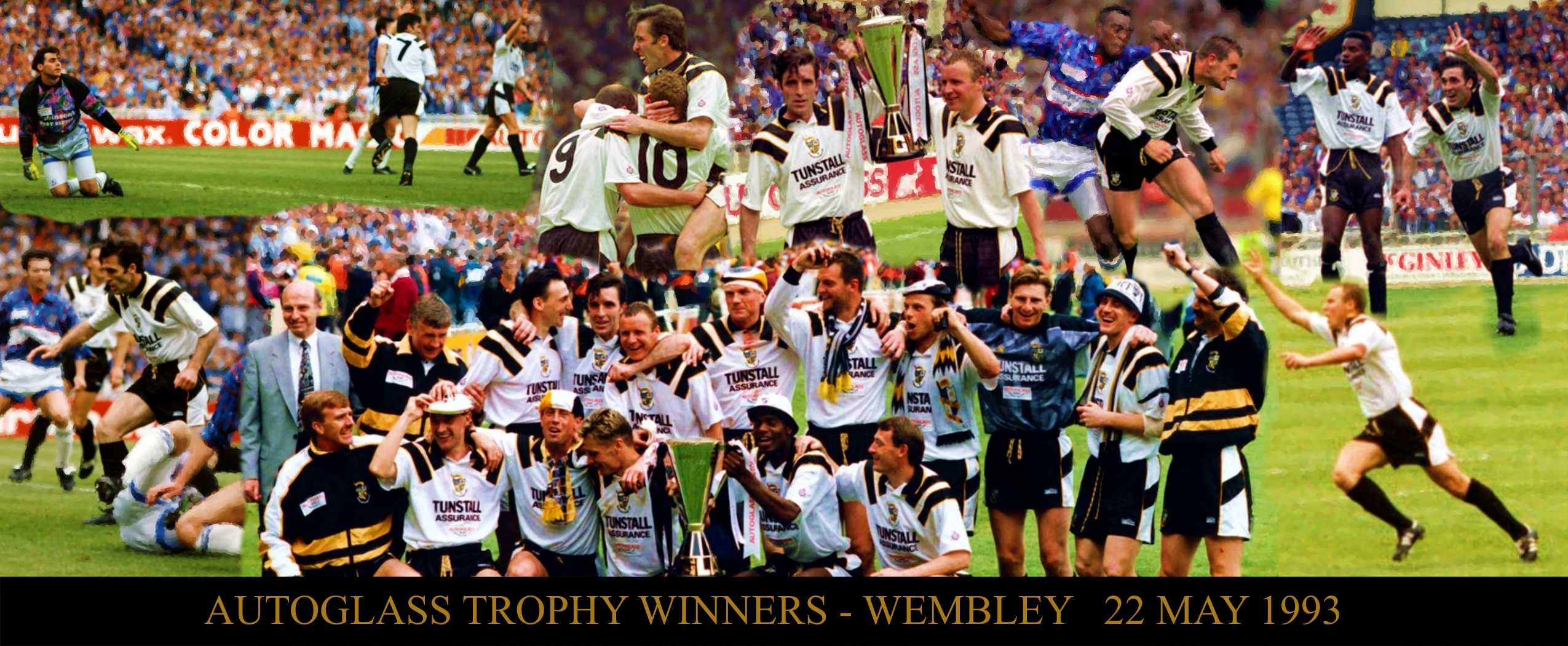
The Autoglass Trophy final win
The Football League Trophy Final was the first time that the Vale had played at Wembley. I remember that we had beaten Stockport 1 – 0 at the Vale in a league match just before the final.
Their goalkeeper, Edwards, had played a blinder that day and I had nearly given up on the Vale being able to get the ball past him before we eventually managed to score. I also got neck ache as Stockport missed their midfield out and kept launching the ball up to Trevor Francis – a giant upfront. We didn’t have the same problem at Wembley with Paul Kerr and Bernie Slaven scoring early goals.
I remember on the Sunday welcoming the team back into the Potteries in their open top bus. I’d been to the Stockport game on one of the supporters’ coaches, but had to drive to Wembley 8 days later for the play-off final against West Brom as I had to be at work early on the Monday morning. I remember the parking charge at Wembley exceeding the total cost of my visit the week before. What a disappointment losing was – we’d beaten WBA home and away and had finished the season well ahead of them on points.
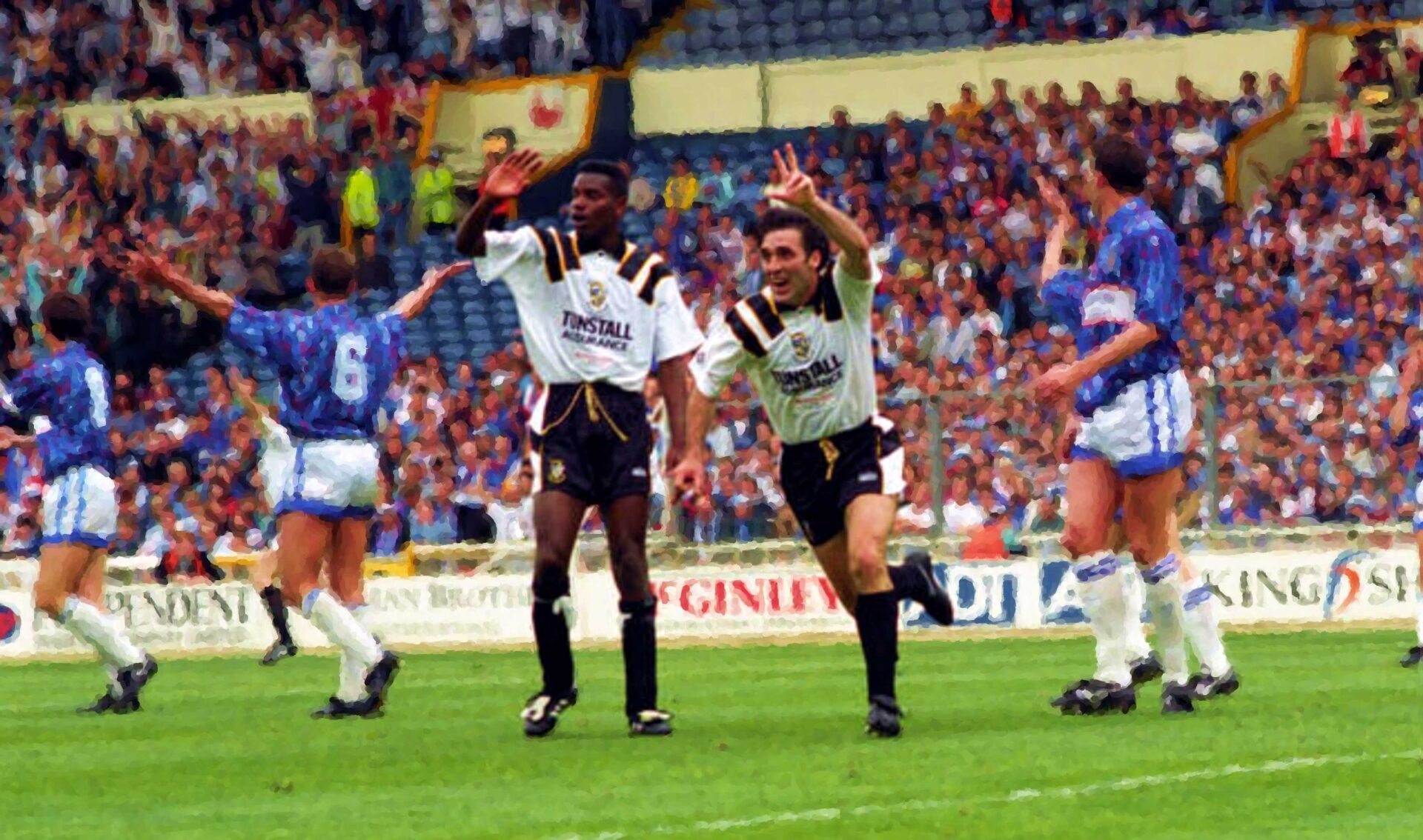
Bernie Slaven wheels away after scoring
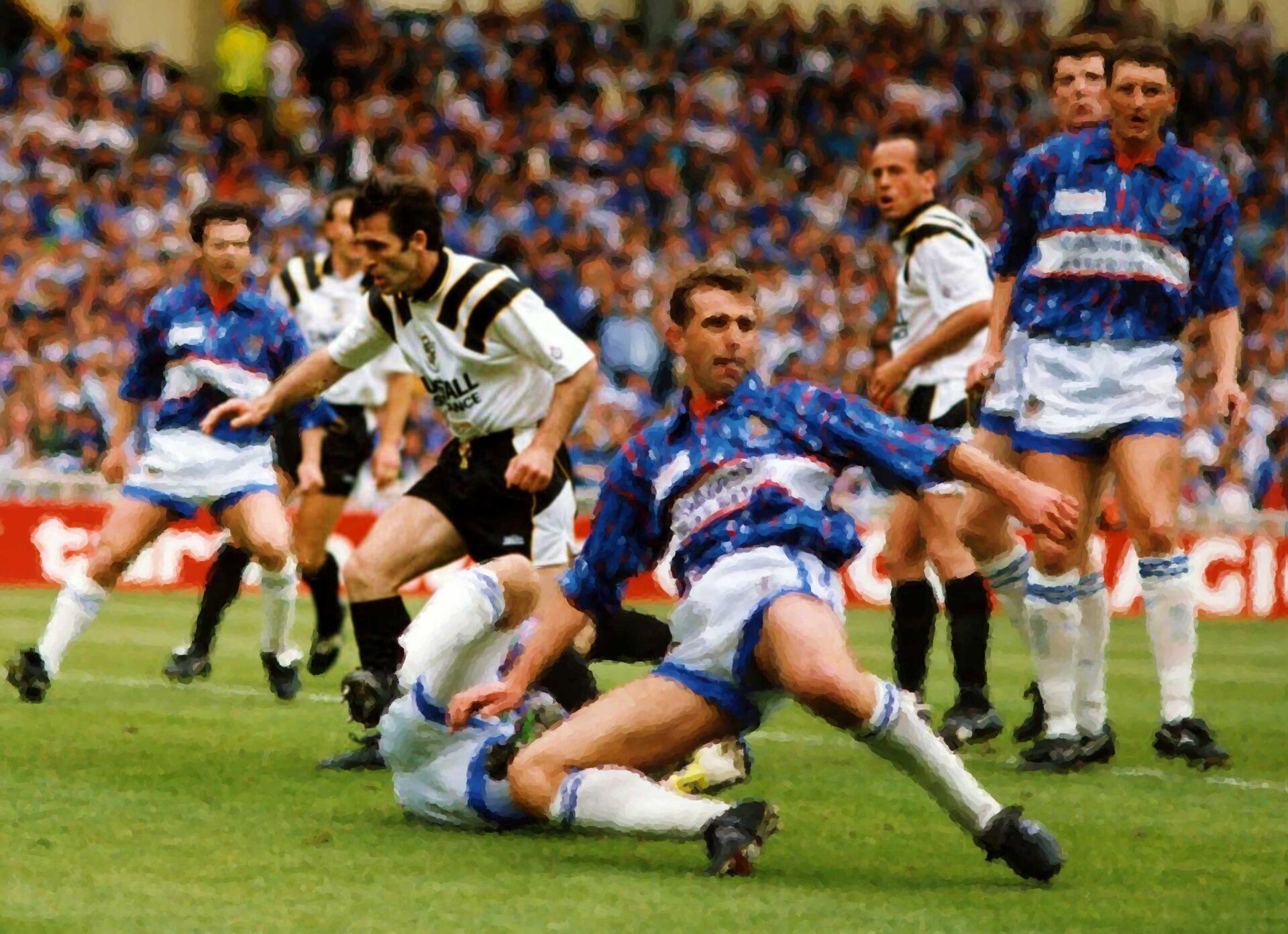
Bernie Slaven battles
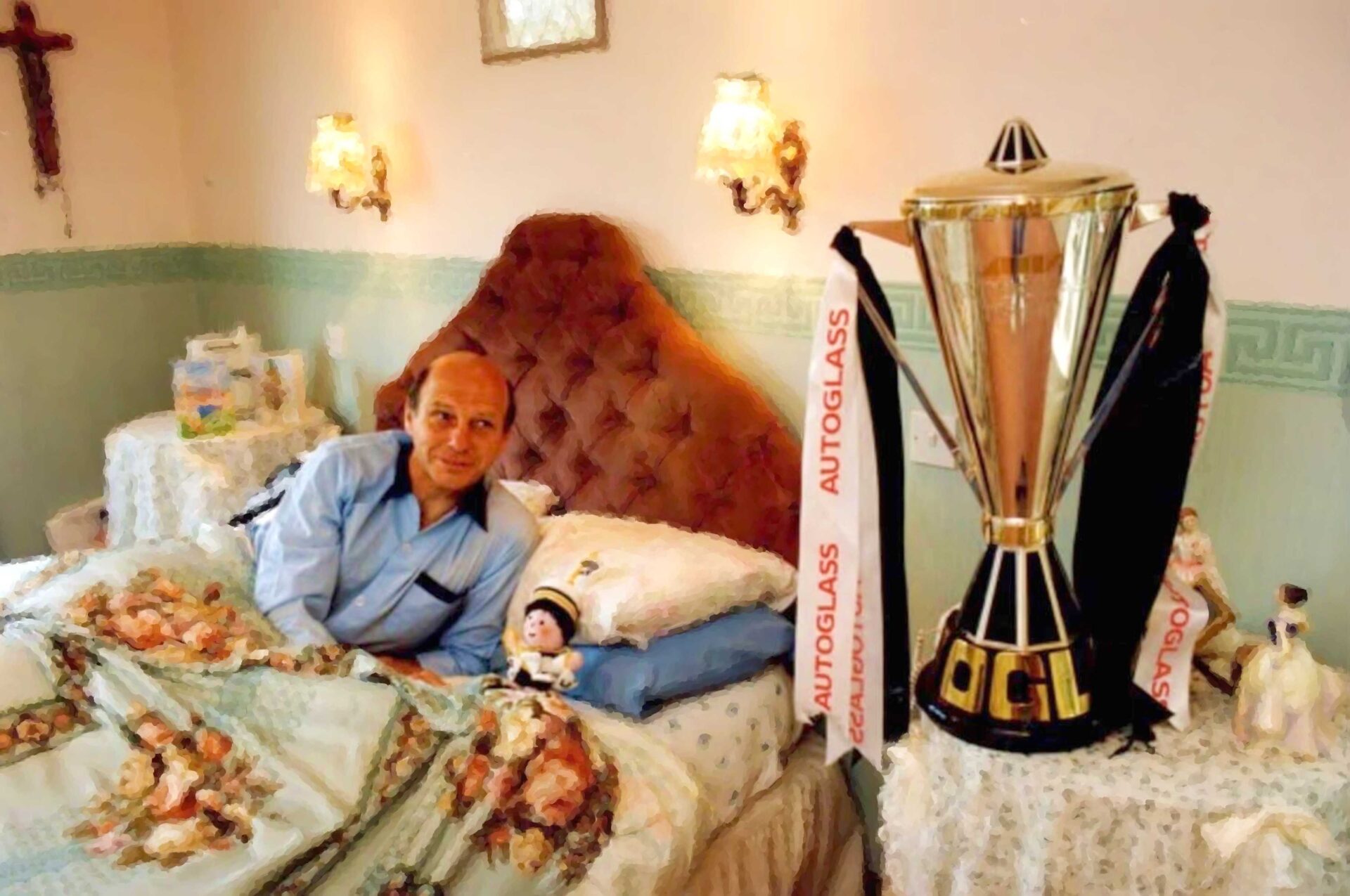
John Rudge with his Trophy
In 1993–94 Port Vale famously secured automatic promotion from the old Division Two on May 7, 1994, by defeating Brighton & Hove Albion 3-1 at the Goldstone Ground. Over 5,000 travelling fans from the Potteries watched as defender Dean Glover opened the scoring in the 14th minute, and Martin Foyle netted a brace to seal the victory and send the Valiants up, despite a late consolation goal from Dean Wilkins. The win was historically significant as it drew one of the largest crowds at the Goldstone Ground in six years, prompting a massive pitch invasion from the jubilant away supporters at the final whistle. Note the “Seth Bottomley” shirts in the photograph of the pitch invasion.
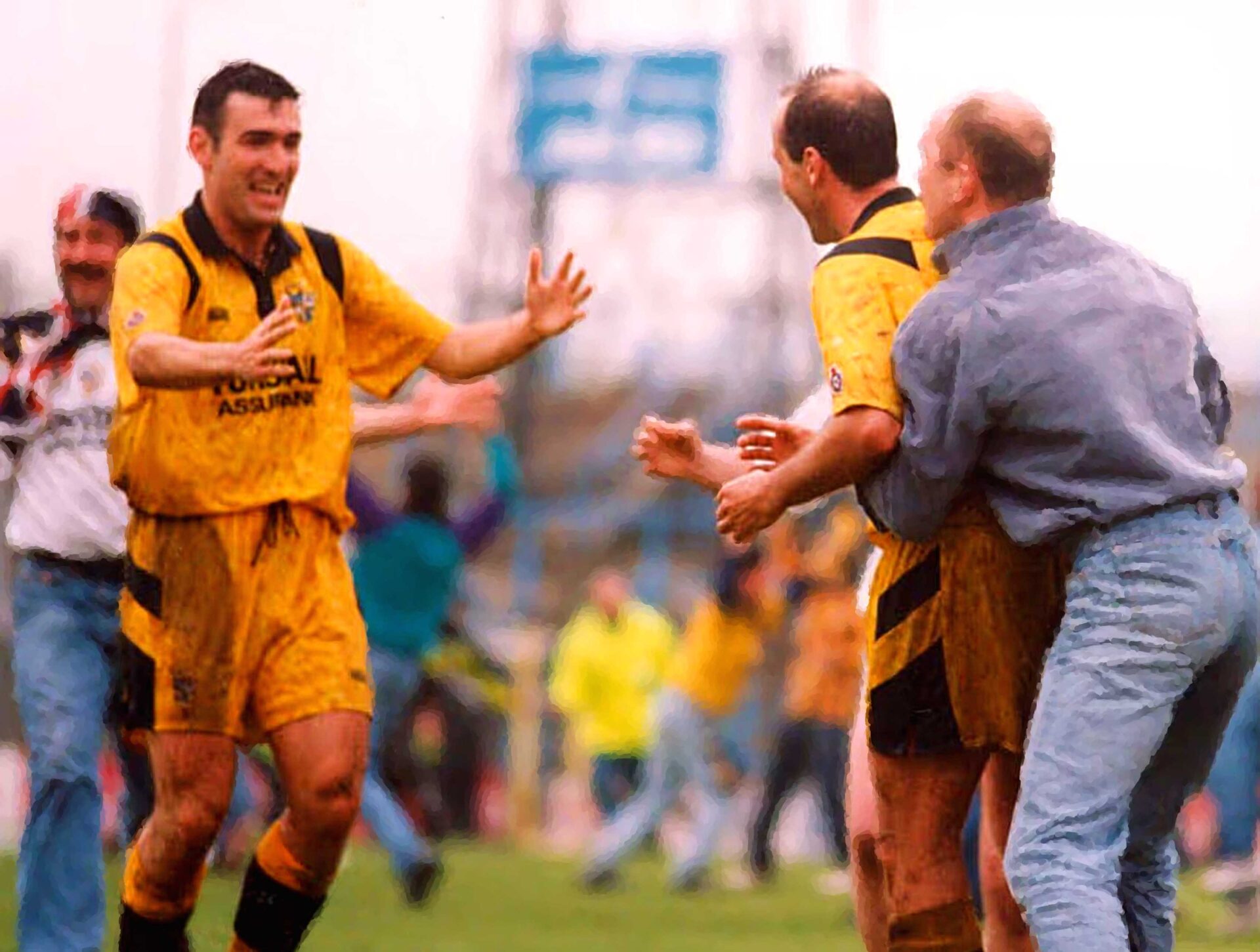
John Jeffers congratulates scorer Foyle
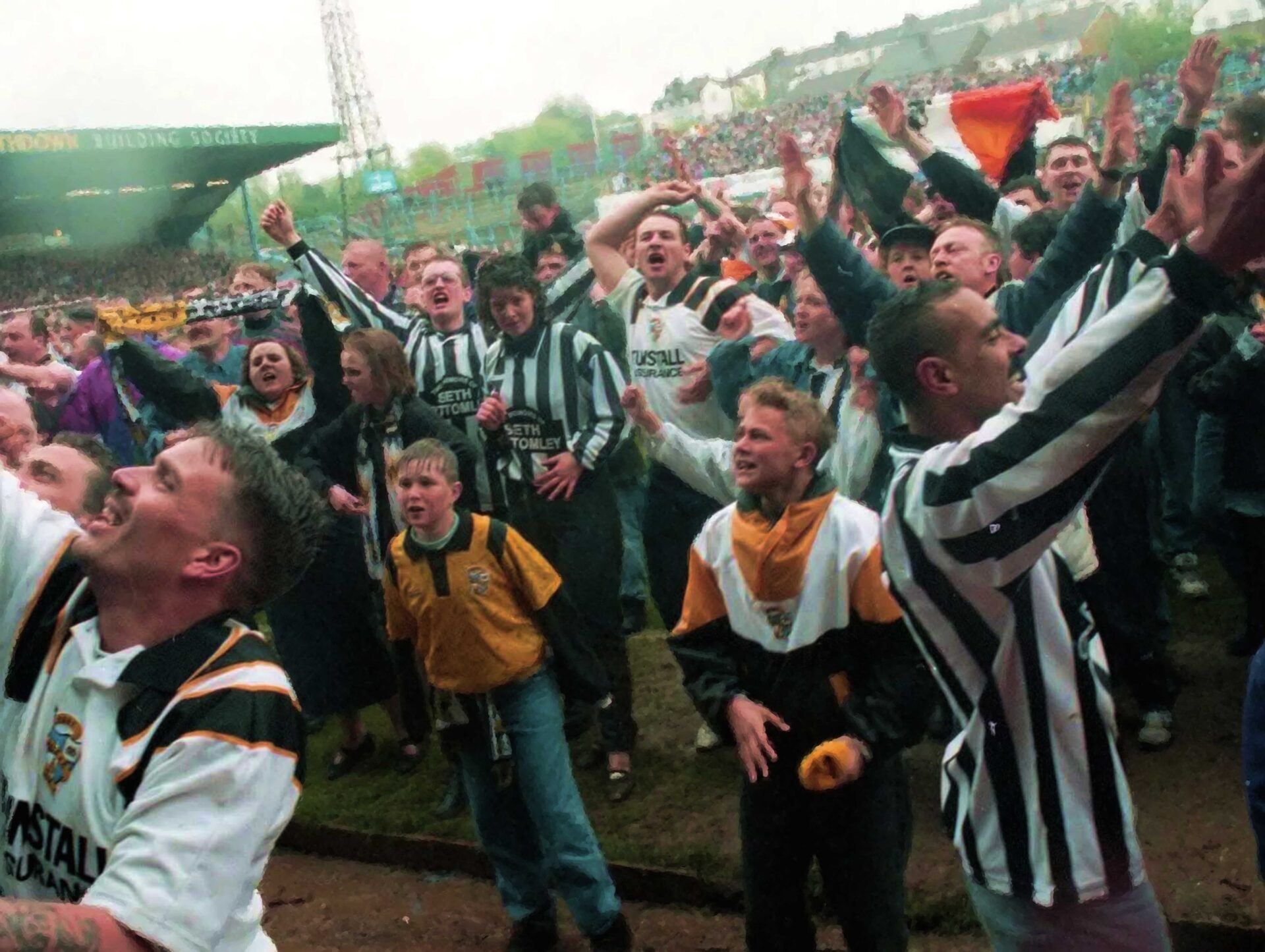
Fan celebrations
A fictitious (but almost-legendary) hard-tackling, old-school right-half who played for Port Vale, Seth was honoured with the highly popular fanzine “The Memoirs of Seth Bottomley” in the late 1980s and throughout the1990s. It routinely poked fun at rivals Stoke City (and their fanzine The Oatcake) and frequently played on the geographic confusion surrounding Port Vale (joking that the club was an island tax haven or located between Southport and Morecambe).
It achieved national legendary status thanks to the late BBC Radio 1 DJ John Peel. Peel was famously fond of independent fan culture and routinely praised The Memoirs of Seth Bottomley on his late-night radio shows. The creators of the fanzine invited Peel as their guest to Wembley Stadium for the 1993 Autoglass Trophy Final, where he watched Port Vale defeat Stockport County 2–1.
I’ve read a lot of fanzines in my time supporting the Vale but this one stands out from the rest. My favourite was issue 21 which was published just before the first derby at the old Victoria Ground in ages. The cover was a view into the away dressing room with Rudgie going through tactics with the Vale players while Lou Macari was outside dressed as a tartan clad spiv running a book on the result. I think Beeston was odds on to be sent off. I’ve never laughed so much in all my life. The legendary status of Seth has been recognised by the club who have installed a board dedicated to the fanzine and its creators in Tommy Cheadle’s.
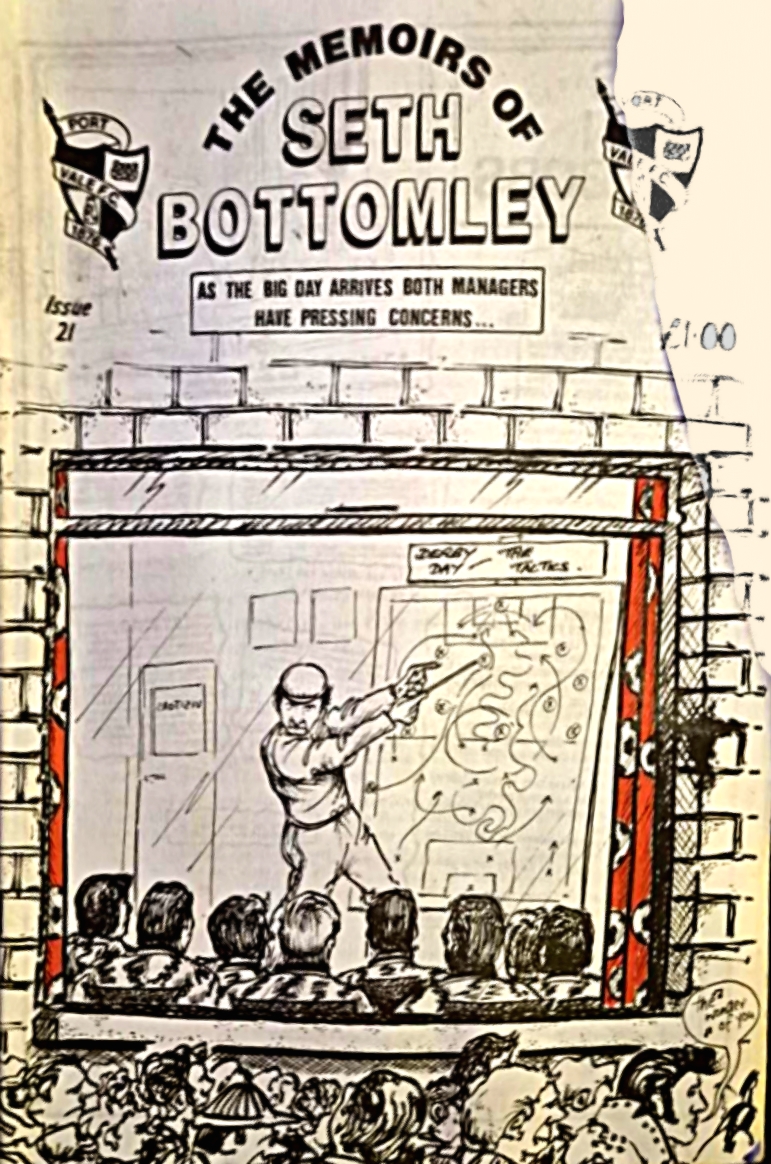
Football's finest fanzine
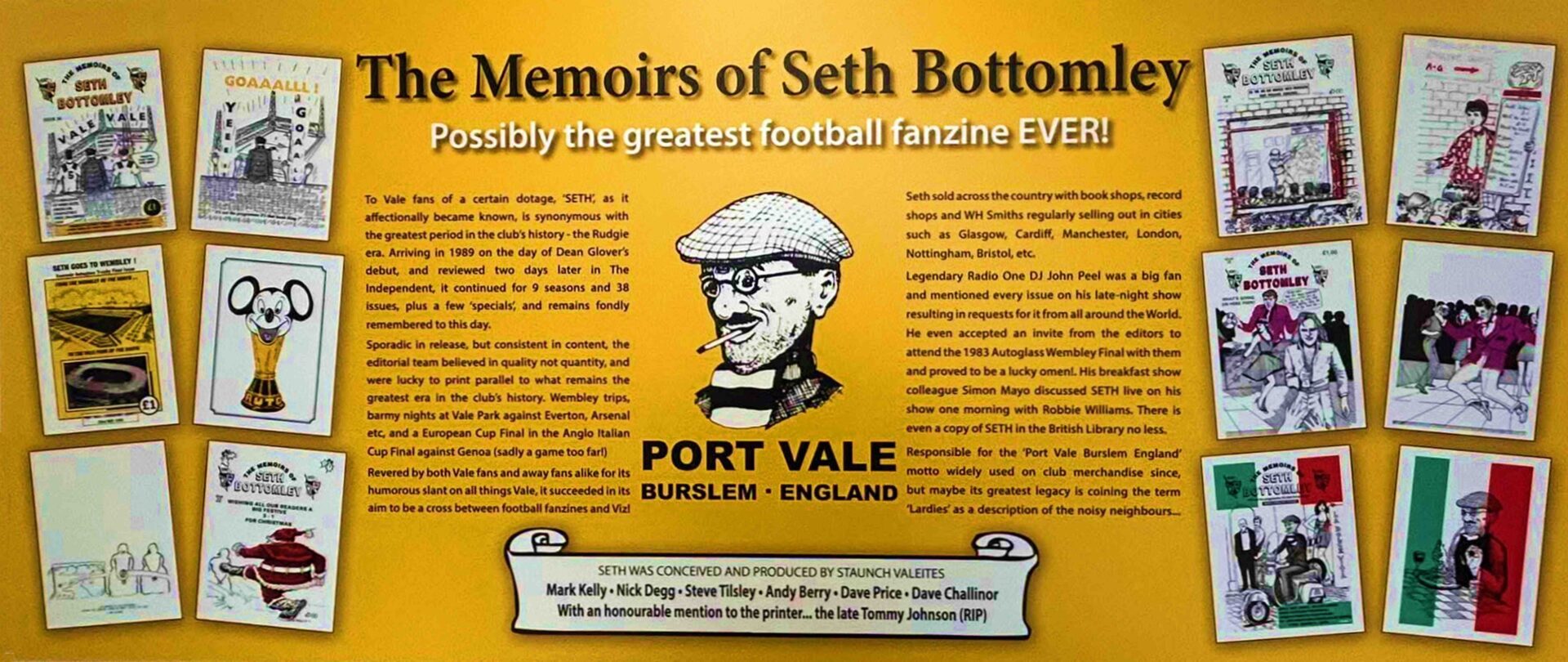
The memorial board to the fanzine
We also beat Premier League side Southampton in the FA Cup. All this was achieved without star midfielder Ray Walker, who was forced to sit out the entire campaign with a cruciate ligament injury. The hangover of the play-off final had continued up until mid-September, at which point they won eight games out of ten to climb to the top of the table. Six wins from eight league games also won Rudge the Second Division Manager of the Month award for April. At the end of the season, Ian Taylor was sold to Sheffield Wednesday, becoming the club’s first million-pound sale. Rudge was also approached to manage Stoke City but declined chairman Peter Coates’s offer. Rudge was very unhappy with Bell for refusing to pay him a promotion bonus that had been verbally agreed, and strongly considered accepting Bradford City chairman Geoffrey Richmond’s offer to manage his club with a 25% salary increase until a gathering of hundreds of Vale fans outside the stadium convinced him to stay put.
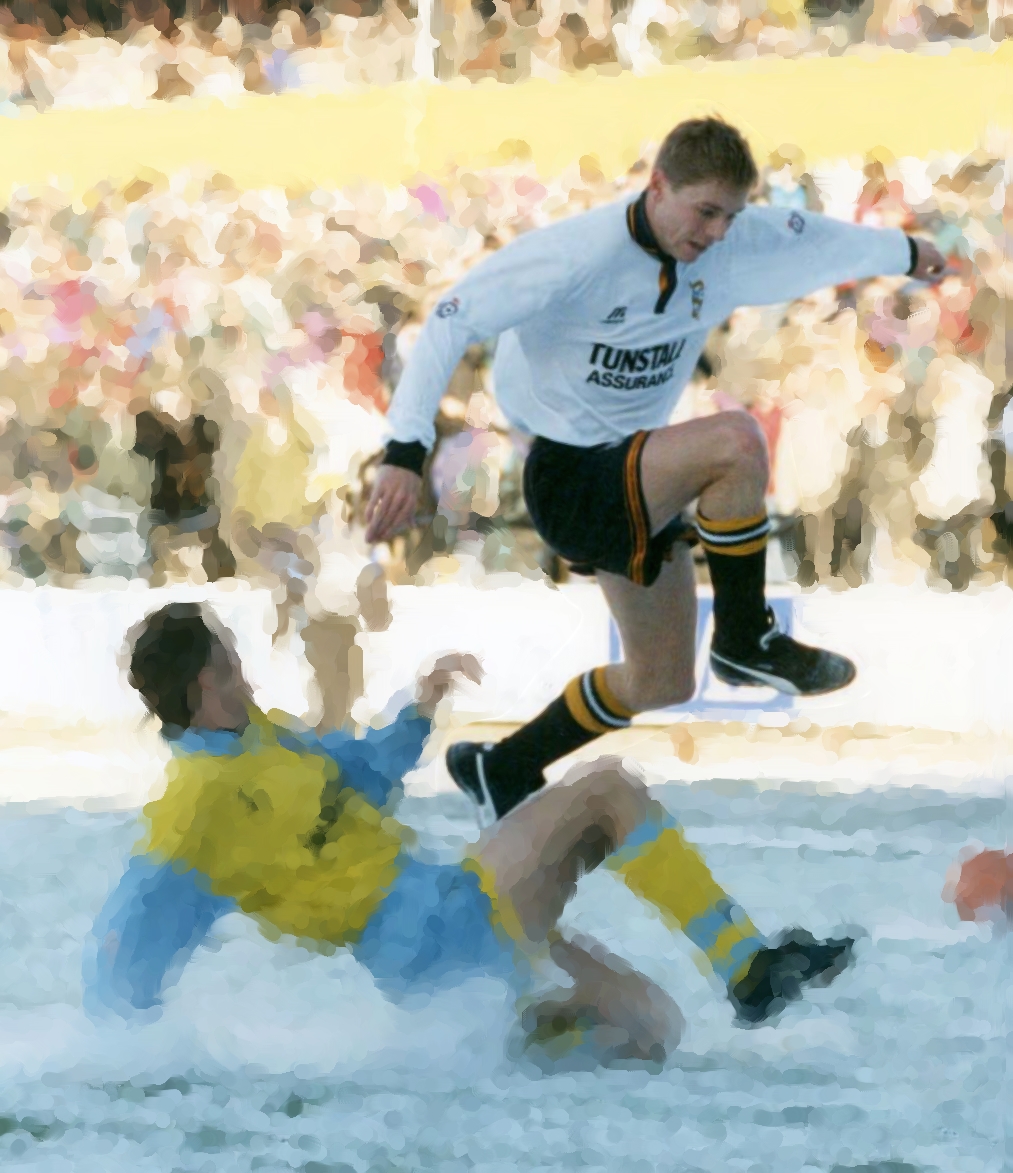
Steve Guppy
The money from Taylor’s sale was reinvested into the playing squad, with £225,000 going to Newcastle United for Steve Guppy. A winger, he started his senior career with Wycombe Wanderers in 1989; over five years he made around 200 appearances for the club, helping Wycombe win promotion to the Football League. Earning a move to Newcastle United in 1994, he made one first-team appearance as a substitute in the League Cup in Newcastle’s 2–0 defeat of Manchester United.
He subsequently moved on to Port Vale in November 1994 for £225,000. He later recalled seeing a local newspaper headline “‘Vale sign Premiership star’ and thought “Great! Who else have they signed?” but of course the headline was about himself. He thought – “but I’ve only played a handful of games in the Premiership I’m hardly a star!”. Two days after signing for the club, on 26 November, Guppy made his debut in a 2–1 win over Millwall, where he collected assists for both goals. He played in the 1996 Anglo-Italian Cup final, as Vale lost 5–2 to Genoa. In nearly three seasons at the then First Division club, he became a fan favourite and a club legend after his memorable performances on the left wing. In February 1997, he was tracked down by his former boss Martin O’Neill, who paid £850,000 to take him to Premier League club Leicester City.
After four years with the “Foxes”, he moved to Scotland to play for Celtic. In 2004, he returned to Leicester before brief spells with Leeds United, Stoke City, and another return to Wycombe. In 2005, he joined American club D.C. United, and after another year returned to the English non-League scene with Stevenage Borough. He retired in 2008 following a spell in the States with Rochester Rhinos. In addition to a successful 19-year club career, he earned England caps at under-21, semi-pro, ‘B’, and finally at full senior level.
A £150,000 fee was also paid to bring striker Tony Naylor in from nearby Crewe Alexandra. Naylor had moved to Dario Gradi’s Crewe from non-League Droylsden in 1990, turning professional at the age of 23. After two successive promotion-hunting campaigns ended at the play-off stage, he helped Alex to automatic promotion in 1993–94. His goals impressed John Rudge, and a £150,000 deal was struck between the two rival clubs in July 1994. He went on to spend the next seven years at Vale Park, playing in the Anglo-Italian Cup final in 1996, as well as the club’s Football League Trophy success in 2001. He soon formed a very effective strike partnership with Martin Foyle.
On 14 March 1995, Naylor scored in a 1–1 draw with Stoke City in a Potteries derby game at Vale Park. He came off the bench in the 1996 Anglo-Italian Cup final, as Vale lost 5–2 to Genoa. He was with the “Valiants” through one of the club’s most successful periods as they finished eighth in the 1996–97 First Division (the club’s highest finish since the 1930s), with Naylor claiming 20 goals in 49 appearances, including a hat-trick past Charlton Athletic whilst playing as a lone striker in a 3–1 win at The Valley on 14 December. After the match he said he hated playing as a lone striker but conceded that “it worked ok today”. In total, he managed to notch 90 goals in his seven years at the club, finishing as the club’s top goalscorer at the end of the 1995–96, 1996–97 and 2000–01 seasons with 12, 20 and 21 goals respectively.
He scored a brace in a 3–1 win over Sunderland on 23 August 1997, showing his “sublime skill”. He nutmegged Andy Melville on a run that began just inside the Sunderland half and ended with a swerving right-foot shot into the corner of the net.
He lost his first-team place in the 1999–2000 relegation season as new manager Brian Horton preferred Manchester United loanee David Healy. He regained his place in the first XI in the 2000–01 campaign, when he formed a strike partnership with Steve Brooker and scored 20 goals. The club also managed to win the Football League Trophy in 2001, as they defeated Brentford 2–1 in the final at the Millennium Stadium in Cardiff; he won a penalty and also had a goal ruled out for offside.
Naylor’s last goal for the club was also the last goal at Oxford United’s Manor Ground in May 2001. Naylor left the club after rejecting a two-year contract that would have seen him take a 40% pay cut. Three times Vale’s top-scorer, he left on a free transfer to Cheltenham Town in 2001. He helped Cheltenham to win promotion via the play-offs in 2002 before he entered the non-League scene with Telford United in 2003. He retired as a player in 2005.
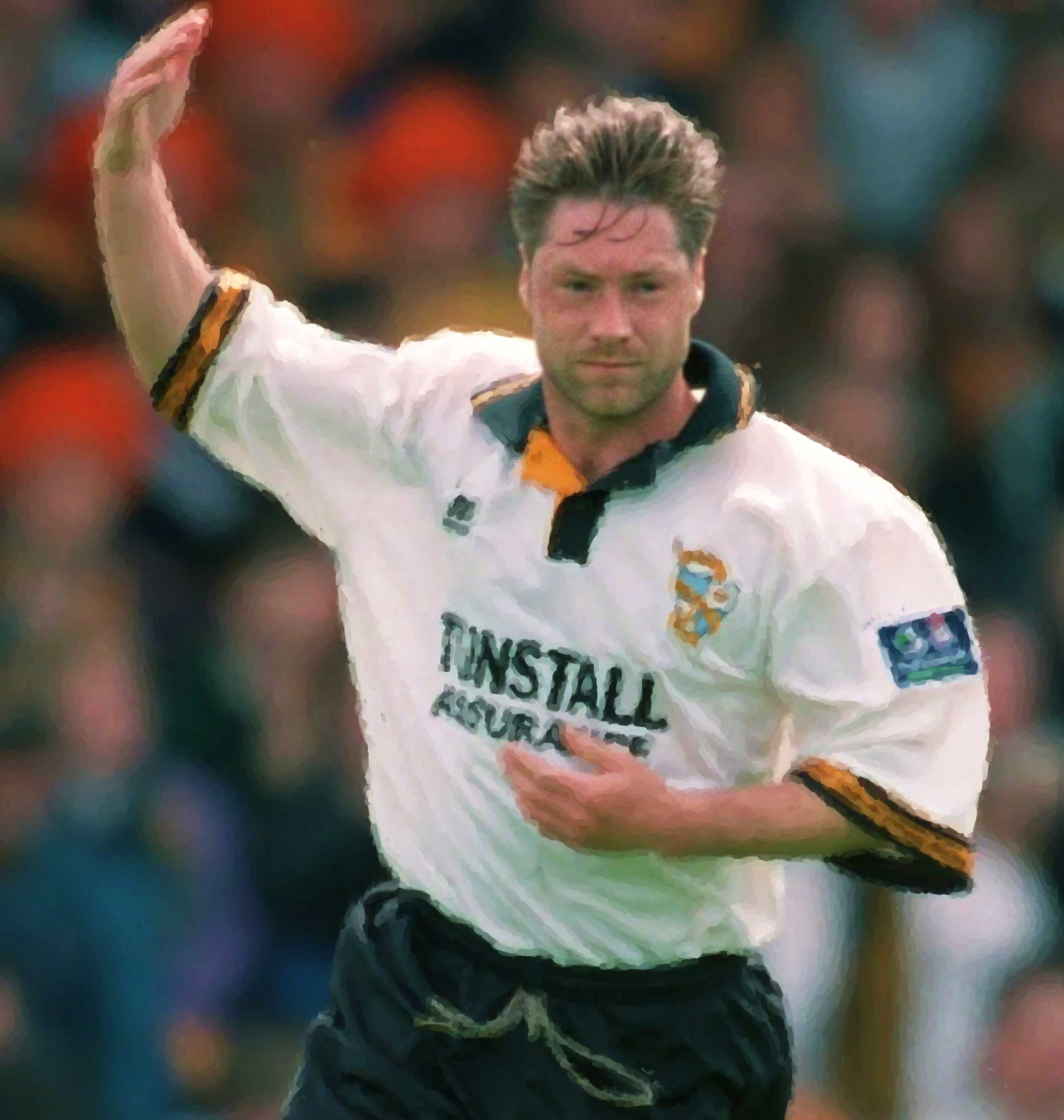
Tony Naylor
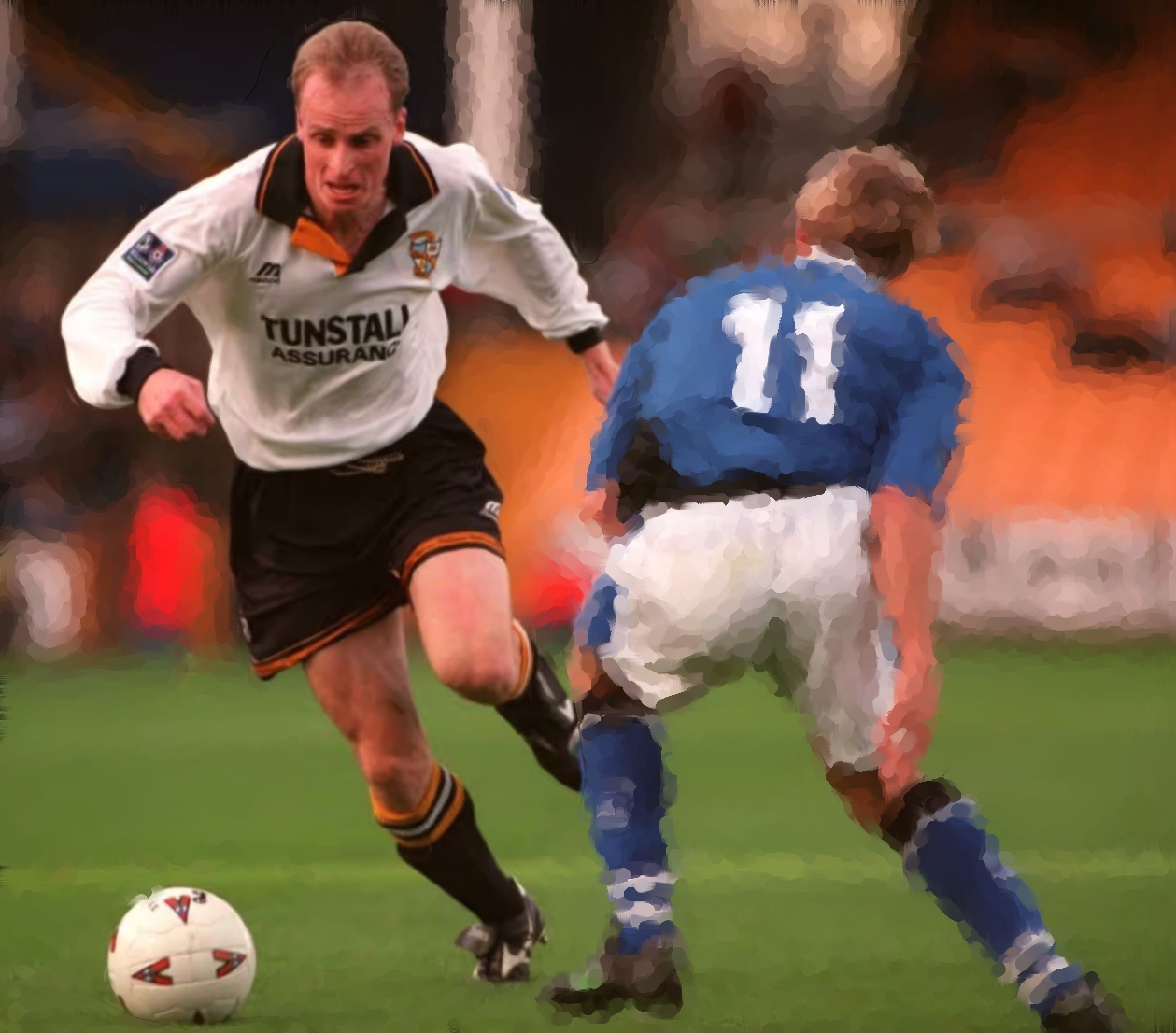
Jon McCarthy
The club consolidated their First Division status in 1994–95, finishing ten points above the relegation zone. At the end of the 1994/95 season, Van der Laan was sold to Derby County for £475,000 plus Lee Mills (Mills would go on to win the club’s Player of the Year award in 1998). Of this sum, £450,000 was reinvested in York City midfielder Jon McCarthy. McCarthy played as a winger and made around 700 appearances in his career, many of which were in the English Football League. Twice a Northern Ireland B international, he went on to win 18 senior caps for Northern Ireland.
He began his career at Hartlepool United in 1987 before heading into the non-League scene with Shepshed Charterhouse in 1989. He returned to the professional game the following year after signing a contract with York City. He spent the next five years with the club, helping York to promotion via the play-offs in 1993, and twice being voted Clubman of the Year. He was bought by John Rudge for a £450,000 fee in August 1995, which at the time was York’s record transfer fee received. With McCarthy on the right-wing and Steve Guppy on the left-wing, Rudge played attacking wing-based football.
During his spell with Vale, McCarthy earned plaudits for his league performances and his display in the club’s FA Cup tie against Everton, scoring the winning goal in a 2–1 victory at Vale Park. He played in the 1996 Anglo-Italian Cup final, as Vale lost 5–2 to Genoa. He won the club’s Player of the Year award in 1996. He played over 100 games within two seasons at Vale Park before he was snapped up by Birmingham City manager Trevor Francis in September 1997, who paid Vale a £1.5 million fee for him. Vale had offered him a new three-year deal as his current contract was due to expire the following summer, which he had rejected in favour of a move elsewhere.
The highlight of a five-year injury-plagued stay in Birmingham would be a League Cup final appearance in 2001. The next year, he was loaned out to Sheffield Wednesday before a return to Port Vale which was followed by a brief spell with Doncaster Rovers and a cameo return at York City. Settling with Carlisle United, he left the Football League in 2003 to play for non-League Hucknall Town.
Another £50,000 was spent on midfielder Ian Bogie. He started at Newcastle United in the mid-1980s, signing for Preston North End in 1989 and moving on to Millwall two years later. In 1993, he joined Leyton Orient, and after another two years, moved on to Port Vale. A legend at the Vale, he made over 150 league appearances. At Vale Park, Bogie began putting in the sort of consistent match-winning displays that had evaded him until this time.
A favourite with the Vale fans, he was a member of the giant-killing Vale team that knocked Everton out of the FA Cup in 1996 and reached the final of the Anglo-Italian Cup at Wembley, eventually losing out to Genoa. He scored twice against Everton, a late equaliser in the original tie at Goodison Park and then once again in the replay. His cult status was elevated further by his penchant for scoring winning goals against local rivals Stoke City. In a 1–0 victory at Vale Park in 1996, Bogie silenced the Stoke City following with a winning goal just 12 seconds after the kick-off. This would be the quickest goal ever scored by a Port Vale player and was described by Bogie as “one of my best-ever goals.”
In five years at Vale Park, Bogie played 180 games in all competitions scoring 12 goals, before being handed a free transfer in April 2000 and signing a two-year contract with Conference National champions Kidderminster Harriers in August of that year. He later described his spell at Vale Park as “the best time of my career.” He moved into management once his playing career had finished, taking up the reins at Gateshead in 2007. He guided the club to two successive promotions via the play-offs in 2008 and 2009 to take them from the Northern Premier League to the Conference National, before he was sacked in December 2012. He was appointed manager of Stockport County in March 2013 but could not save the club from relegation out of the Conference.
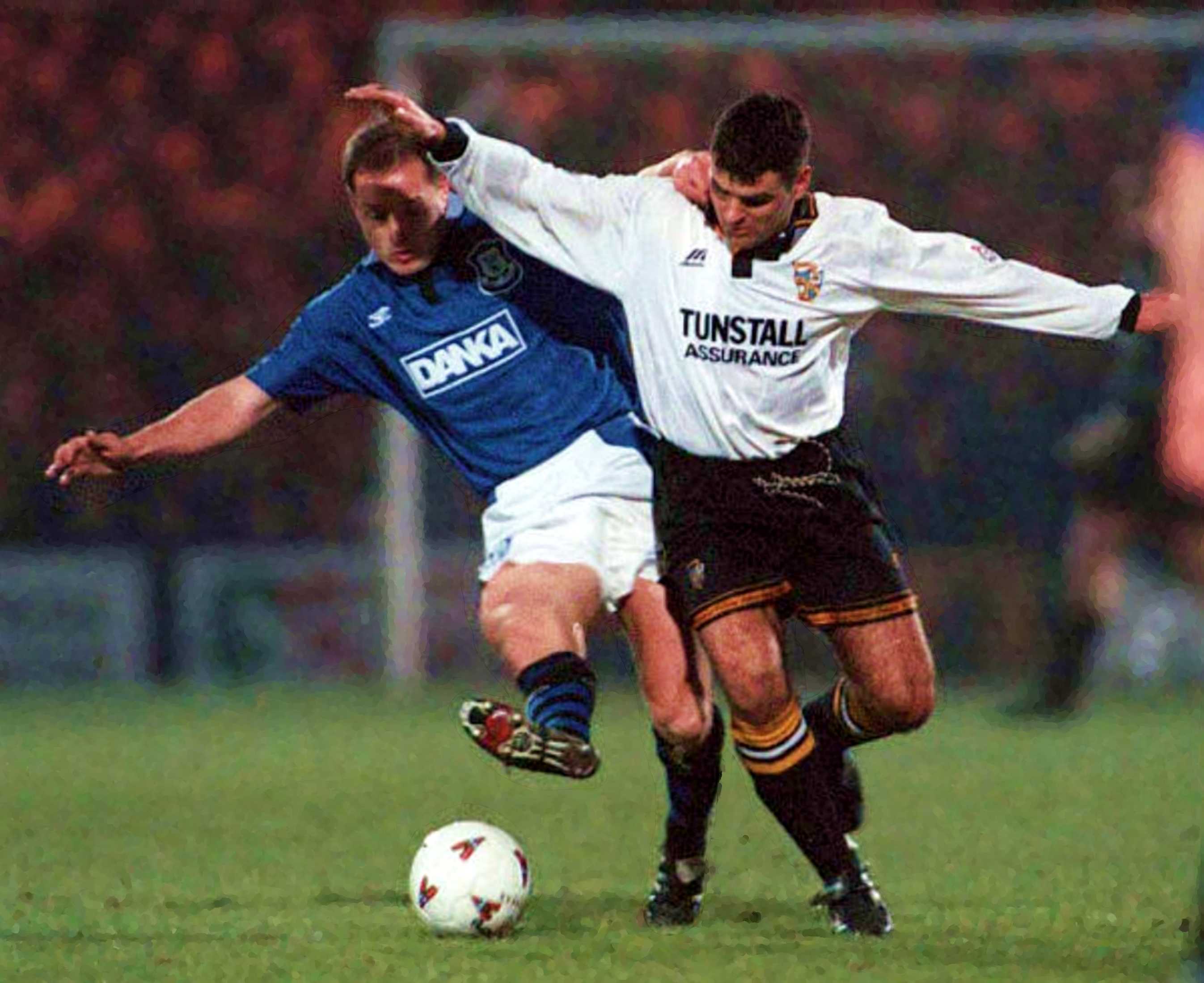
Ian Bogie in action against Everton
Read all the episodes
- 75 years a Vale fan: part one of Stuart Dean’s Port Vale memoirs
- 75 years a Vale fan: part two of Stuart Dean’s Port Vale memoirs
- 75 years a Vale fan: part three of Stuart Dean’s Port Vale memoirs
- 75 years a Vale fan: part four of Stuart Dean’s Port Vale memoirs
- 75 years a Vale fan: part five of Stuart Dean’s Port Vale memoirs
- 75 years a Vale fan: part six of Stuart Dean’s Port Vale memoirs
Share your thoughts on these memories and post a comment below



Another excellent installment. I think the Stockport County striker named here as Trevor Francis was in fact Kevin Francis.