





The fifth instalment of long-standing Port Vale supporter Stuart Dean’s memoirs of decades supporting the club…
This is part six and continues to reflect on the John Rudge glory years.
75 YEARS OF SUPPORTING THE VALE - PART SIX

By Stuart Dean
Following victory over Bristol Rovers in the play-off final, for the first time in thirty-two years, Vale were in the Second Division. A new club record had been set in January 1989, as Rudge purchased defender Dean Glover from Middlesbrough for £200,000; the signing was a necessary short-term one to maintain the promotion push as both Hazell and Sproson were injured, though Glover would remain with the club for the next ten years.
He became an instant hit with Vale fans due to his skilful performances and went on to play both legs of the play-off victory as Rudgie’s team won promotion. Dean became a mainstay of Vale’s defence throughout the 90s, which was one of the club’s most successful periods, forming an excellent partnership with fellow centre-half Neil Aspin.
He was also part of the Vale side that won the Football League Trophy at Wembley in 1993. He was then an ever present the following season as Vale won promotion back to the second tier. He was also selected in the PFA Team
of the Year that season. He then played a major role in the Vale side that achieved the club’s highest finish since 1931, when they finished eighth in the second tier in 1996-97. Dean played for a total of 9 years at the club and his 431 appearances is the fifth highest recorded by any Vale player.
He parted company with the club as a player in 1998 and his send off included a testimonial game in which Robbie Williams played. He later returned to the Vale as a coach prior to roles as caretaker manager for periods in 2007 and 2008 and then manager for most of the 2008-09 season. Dean’s association with the Vale
extended to over 18 years in total as a player, coach, manager and also included a spell as scout in 2015.
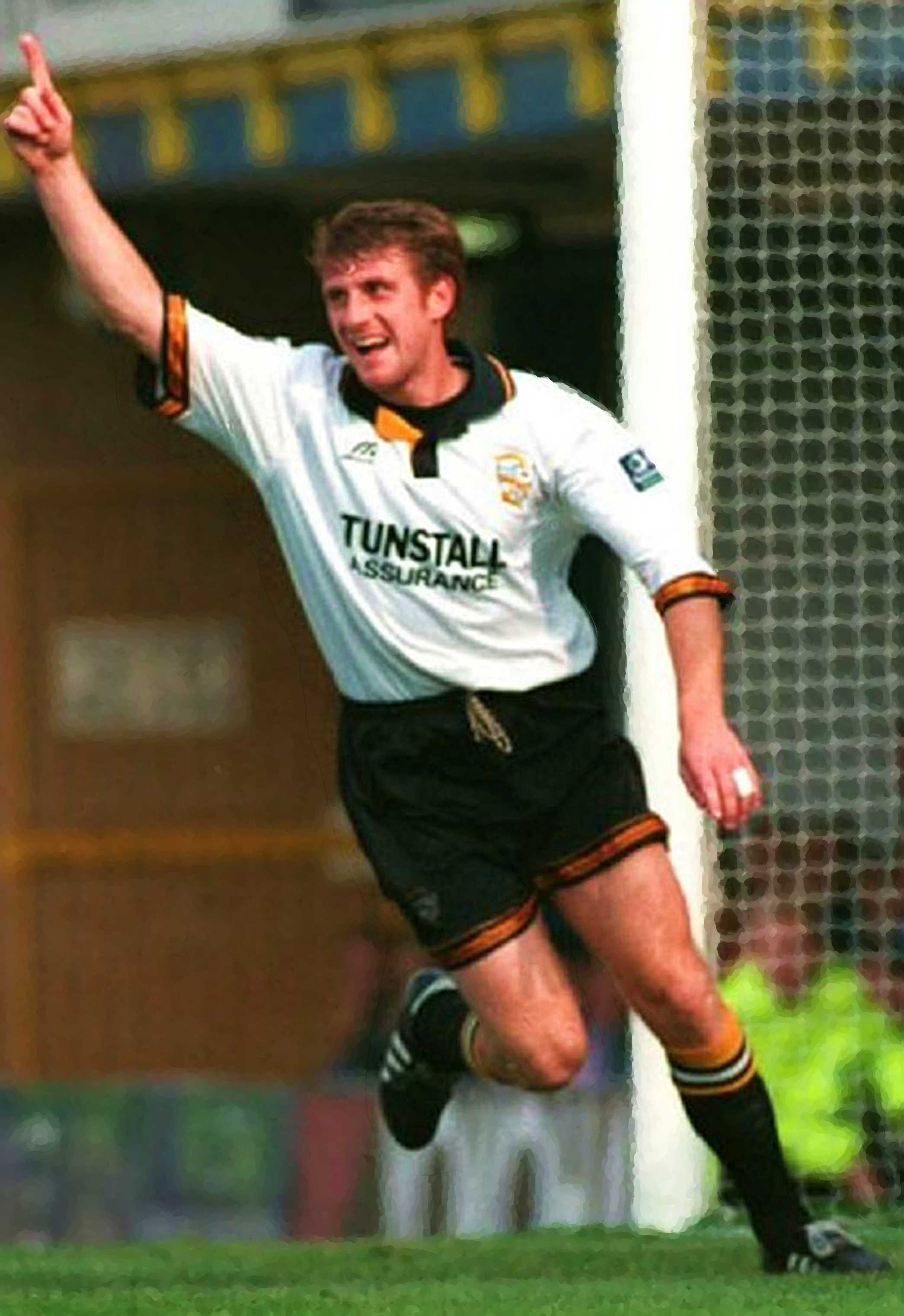
Dean Glover
John Jeffers
The next month Rudge added Liverpool winger John Jeffers to the squad for £35,000, using the money he received from selling Steve Harper to Preston North End.
“Jinkin” John Jeffers was born in Liverpool, showing a natural gift for football from an early age. He played 7 times for England schoolboys during the 1984 season and signed for Liverpool in 1986. After two seasons at Anfield, Jeffers struggled to make a first team appearance and left to join Port Vale, initially on loan in 1988.
Rudgie said: “I remember watching him play for Liverpool reserves and I knew within the first 45 minutes that I wanted to sign him.” After just a couple of games, Jeffers showed his ability down the left wing and soon became a firm favourite of Port Vale supporters, making a permanent move to club for £30,000.
During his eight seasons with Port Vale, Jeffers made a total of 219 appearances and helped the side win two promotions. In 1995 after suffering a number of injuries, Jeffers moved on loan to Shrewsbury Town, making five appearances. Following his time at Port Vale and Shrewsbury, Jeffers joined Stockport County in August 1995, making his full debut on 18th November 1995.
He will always be remembered by Stockport County fans for his part in the 1996-97 season. He appeared in 48 games for the club during their prolific season and came off the bench to secure the only goal against promotion rivals Watford in April 1997. His professional career came to an end in August 1997, following an injury.
To boost the side for the upcoming 1989–90 season, defender Neil Aspin was purchased from Leeds United for £150,000; Aspin would play over 400 games for Vale in the next ten years, mainly alongside Glover at centre-back.
A defender who could play at centre-back and right-back, he was a marker and a tackler. He made his debut in the English Football League for Leeds United at the age of 16 in February 1982, which would be his only appearance in the First Division (first tier).
He spent seven seasons in the Second Division (second tier) with Leeds, making 244 league and cup appearances and being named the club’s Player of the Year for the 1984–85 season.
He was sold to Port Vale for a £150,000 fee in July 1989 and would go on to make 410 appearances in all competitions during a ten-season stay at Vale Park. He was named the club’s Player of the Year in the 1989–90 season and helped the “Valiants” win the Football League Trophy in 1993.
Neil Aspin
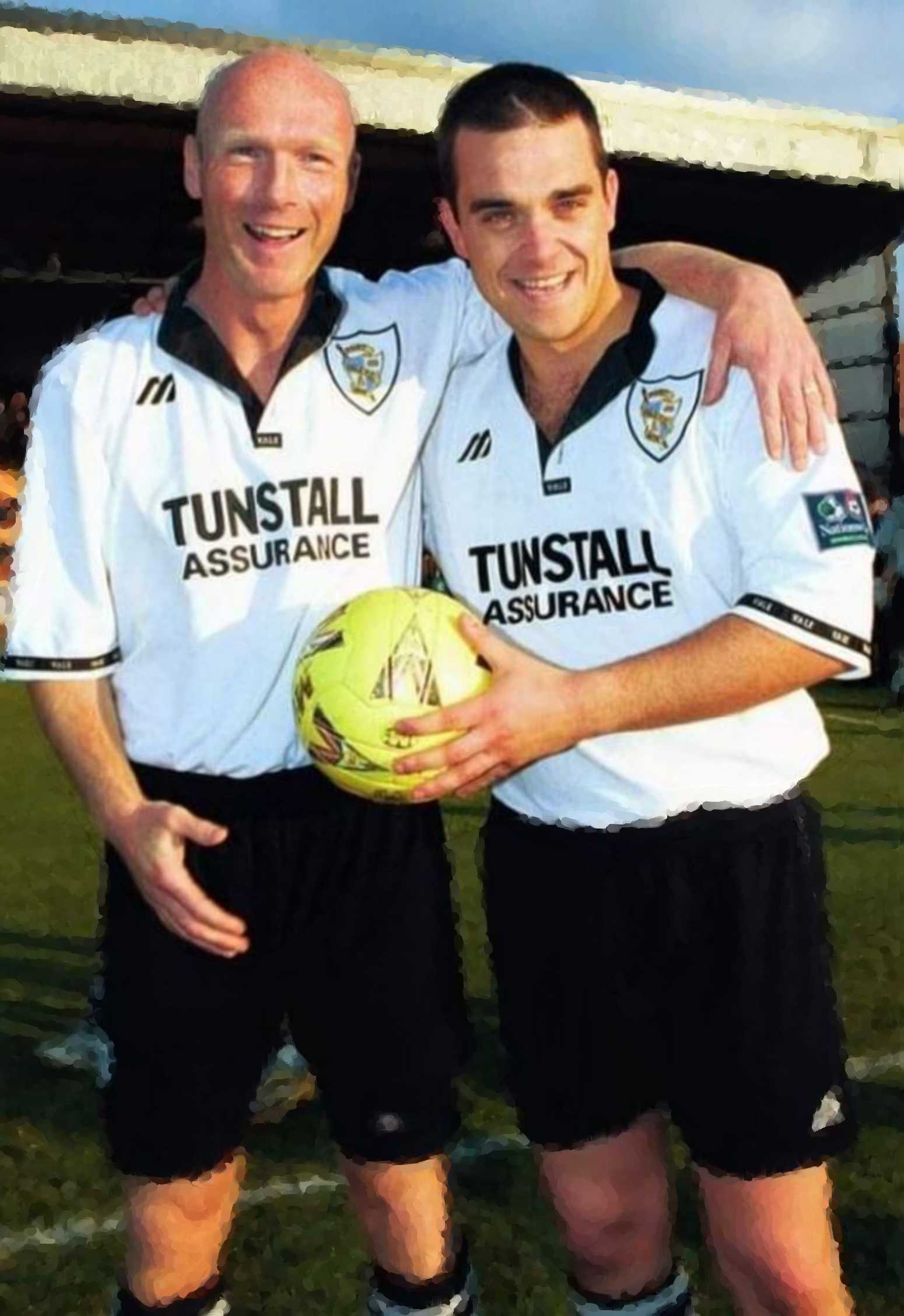
Neil Aspin and Robbie Williams
The following season, 1993–94, he was named on the PFA Team of the Year as he helped Vale to win promotion out of the Second Division (third tier), and he again won the Port Vale Player of the Year award. He also played in the 1996 Anglo-Italian Cup final defeat to Genoa.
He spent July 1999 to January 2001 with Third Division (fourth tier) side Darlington and the second half of the 2000–01 season at Hartlepool United. He played non-League football at Harrogate Town until retiring as a player in 2004, and then managed the club from January 2005 to April 2009. He was appointed as manager of FC Halifax Town in April 2009 and achieved three successive promotions in his first four seasons at the club. However, he was sacked in September 2015 after a series of poor results, and two months later took charge at Gateshead. He spent two years at Gateshead before he was installed as Port Vale manager in October 2017.
He steered the club away from relegation at the end of the 2017–18 season before tendering his resignation in January 2019.
Another outlay, this time of £125,000, was spent prior to the 1989/90 season on striker Nicky Cross from West Bromwich Albion. Nicky would play around 150 games over the next five years. Vale fans were not used to such purchases but, compared to other teams in the division, the money spent was quite modest. Now on a par with Potteries derby rivals Stoke City, both league games ended as draws, though Stoke were relegated in last place to leave Vale in a higher division than their rivals.
John Rudge made few changes in preparation for the 1990–91 campaign, with Kevin Kent as the only major incoming transfer. Vale once again finished comfortably in mid-table. Non-scoring striker Ronnie Jepson was sold to Preston North End for £80,000, which was reinvested in bringing Dutch midfielder Robin van der Laan to the club. Over the next five years the Dutchman became a key player.
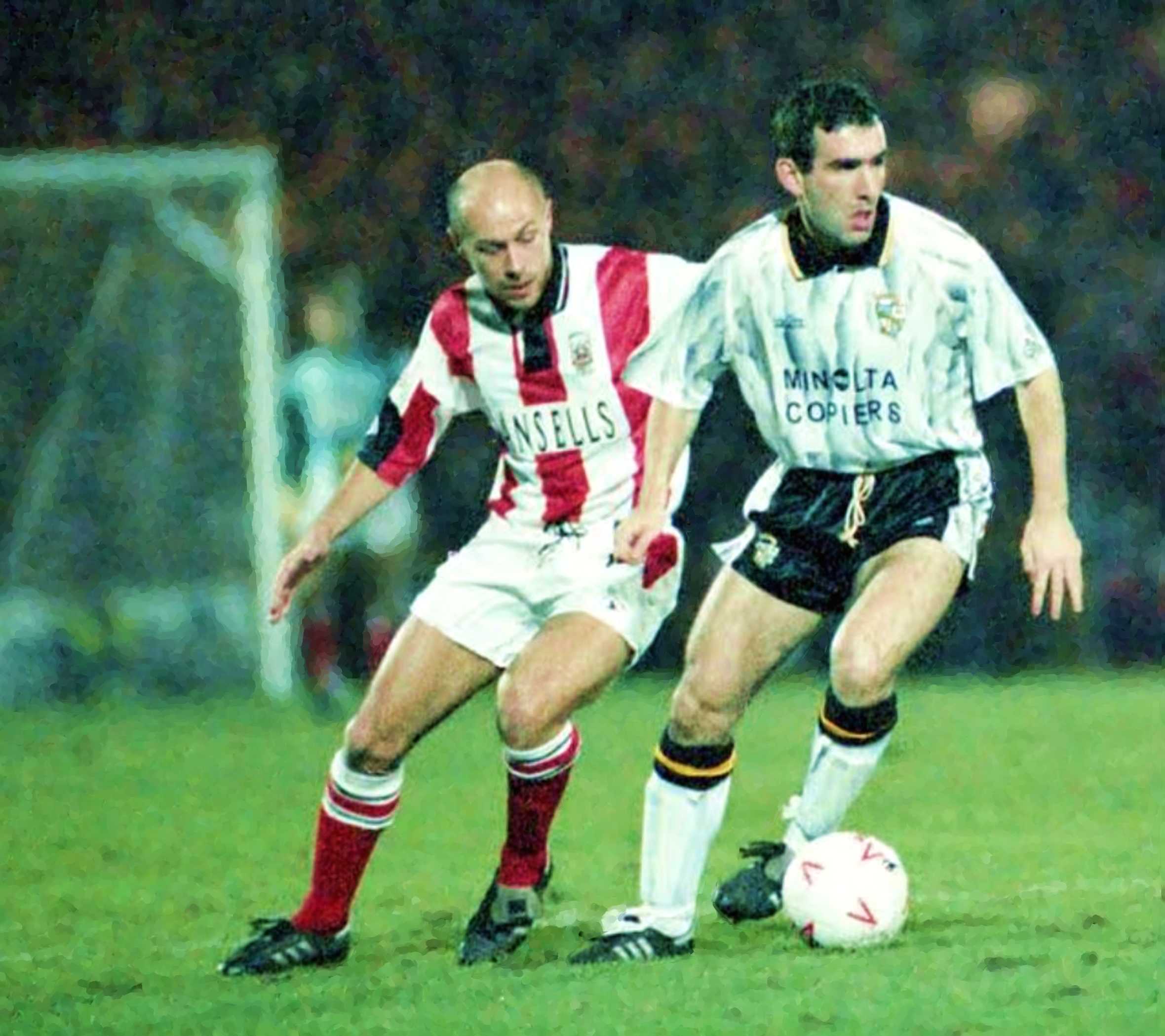
Van der Laan transferred to Port Vale from FC Wageningen in February 1991 for a fee of £80,000, marking the club’s first signing from the Netherlands and providing an immediate boost to their midfield options. Over four seasons from 1991 to 1995, he became a cornerstone of the team, accumulating 210 appearances and contributing 26 goals while adapting seamlessly to the physicality of English lower-division football, drawing on his prior experience in the Dutch Eerste Divisie.
Playing primarily as a box-to-box midfielder, van der Laan excelled in midfield battles through his robust tackling and high work rate, often covering significant ground to support both defence and attack; his precise passing helped maintain possession during transitional play. A standout moment came in the 1992 League Cup third-round tie at Anfield, where he headed Vale into a 2-1 lead against Liverpool in a memorable 2-2 draw, earning chants from travelling supporters and cemented his reputation as a fan favourite.
His commitment shone in other key fixtures, such as a dramatic slide tackle against Wolverhampton Wanderers on a rain-soaked pitch, which exemplified his tenacity in high-stakes encounters. Van der Laan’s contributions were instrumental in Port Vale’s successful 1993–94 campaign, where they secured promotion to the Second Division as runners-up, finishing just one point behind champions Reading after a consistent run of form. Earlier that season, he had also played a part in the club’s victory in the 1993 Football League Trophy final at Wembley, further highlighting his reliability in cup competitions.
His popularity among supporters grew through such performances, earning him cult hero status for blending Dutch flair with the grit demanded by Vale Park crowds.
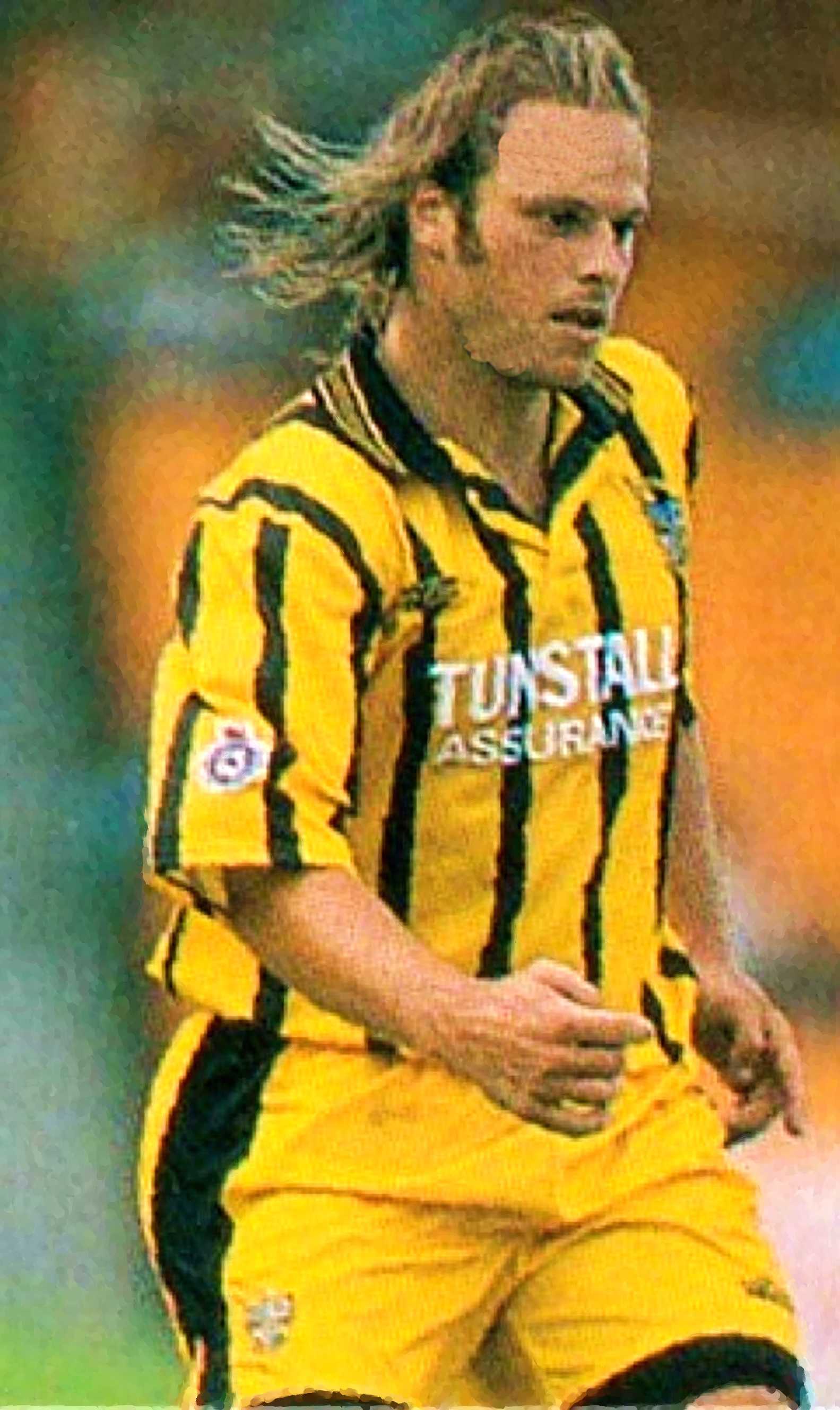
Robin van der Laan
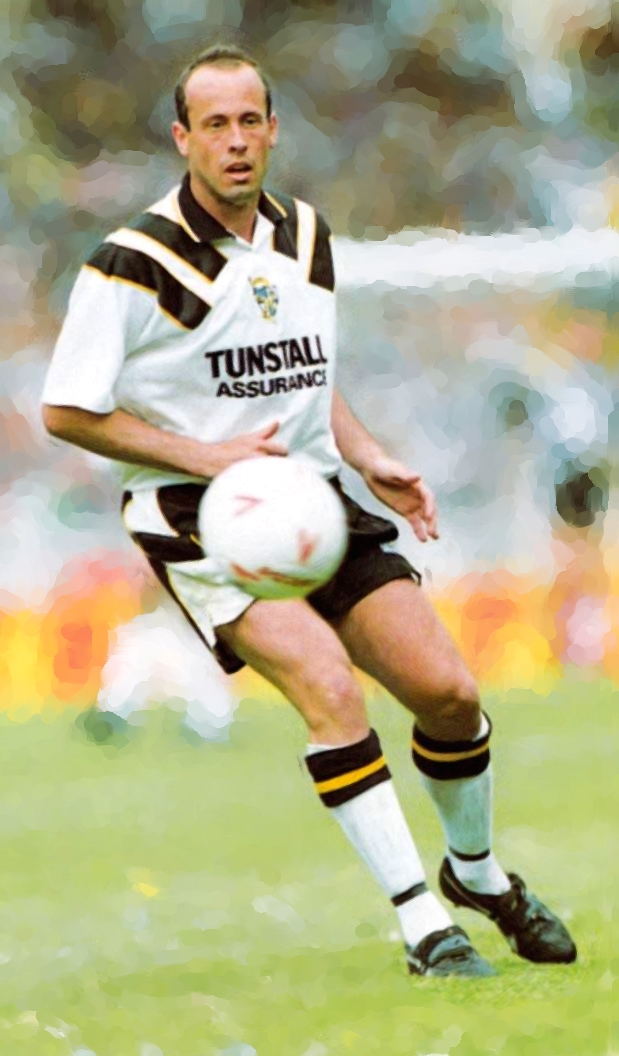
Martin Foyle
In June 1991, Rudge again broke the club’s transfer record, picking up striker Martin Foyle for £375,000 from Oxford United – he went on to score 108 goals in 296 games for the club. Foyle started his career with Southampton as a trainee, and after spending four years at the club, during which he was loaned out on two occasions, he joined Aldershot for a £10,000 fee in August 1984. A £140,000 move to Oxford United followed in March 1987, before he became Port Vale’s record signing.
He was signed as a replacement for Darren Beckford and was convinced to sign for the club by manager John Rudge and chairman Bill Bell, who sufficiently impressed enough for him to reject the opportunity to speak to other clubs. Foyle had wanted to move north and was persuaded by Rudge’s persistence and the opportunity of playing in a strike partnership with Beckford, although Beckford was sold shortly after Foyle’s arrival.
Foyle’s transfer fee of £375,000 was set by a tribunal after Oxford asked for £700,000, and Vale offered £200,000. His first game was against his former club, Oxford, at Vale Park, and he scored both goals in a 2–1 win. Although he finished as leading scorer in the 1991–92 campaign with 16 goals, the club finished bottom of the Second Division that season and were relegated. During the following season, Foyle was part of the team which won the Football League Trophy and narrowly missed out on automatic promotion before losing the play-off final against West Bromwich Albion. He played from the start of the Football League Trophy final win over Stockport County and provided an assist for Bernie Slaven’s goal. He returned to Wembley a week later for the play-off final, which ended in a 3–0 defeat.
He opened the home campaign of the 1993–94 season with a hat-trick in a 6–0 win over Barnet, scoring left-footed, right-footed and headed goals. He ended the season with 18 goals and was again the club’s leading scorer as the club finally achieved promotion in 1994. One of his 20 goals in the 1994–95 season was the winner in Vale’s 1–0 victory in the Potteries derby at the Victoria Ground in 1995, and later he was voted as the club’s player of the year for 1995.
He played in the 1996 Anglo-Italian Cup final, scoring twice as Vale lost 5–2 to Genoa. He scored against Everton at Goodison Park in the FA Cup, which he later said was his most enjoyable goal; the match finished 2–2 and Vale went on to win the replay. In 1998–99 the ageing striker became the club’s top scorer for a fourth time, with nine goals.
During his time at Port Vale, Foyle scored 108 goals, which made him the club’s record post-war goal scorer until Tom Pope overtook this tally in 2020. Some of his important goals include a late equaliser in a League Cup tie at Liverpool in 1991, two at Brighton which sealed promotion in 1994, and one in a game at Huddersfield Town in 1998 which saved the club from relegation.
After retiring as a player, he managed Port Vale’s youth team and, in February 2004, took charge of first-team affairs, eventually leaving the club in September 2007 by mutual consent.
Prior to the 1991 92 season Rudge also brought in Keith Houchen from Hibernian for £100,000 and spent £300,000 on the versatile centre-half Peter Swan. The money for these acquisitions came from the sale of Robbie Earle to Wimbledon for £775,000 and Darren Beckford to Norwich City for £925,000.
Swan began his career with local side Leeds United in 1984 before he moved on to Hull City for £200,000 in 1989. Two years later, he transferred to Port Vale for a fee of £300,000. My standout memory of Swanny was when he was playing centre-forward for Hull against the Vale at Boothferry Park in September 1990. Very early in the game Hull had a corner which Swanny punched out of the penalty box having first rolled his sleeve up – Vale were playing in short sleeves. George Courtney, a referee who never seemed to favour the Vale, was completely conned and gave Hull a penalty which they scored from.
I also remember the game because of a nightmare journey to Hull. I’d picked up a hire car from Teesside Airport and as I drove into Northallerton, a police car filtered in behind me. I noticed immediately and religiously stuck to 30 mph through the town. As I reached the outskirts and started to put my foot down, on came the blue lights and I was pulled over.
I couldn’t answer the officers first two questions – why I’d been stopped and the registration number. At this point I think the officer was convinced that I was driving a stolen vehicle. It turned out that the tax disc on the car had expired. He kept me there for nearly an hour and a half while he carried out various checks. Eventually he issued me with a summons to attend the police station before 9am on the Monday morning, where I would be charged with driving a car without tax – unless it turned out that I was guilty of the lesser charge of failing to display a current tax disc, in which case I would get away with a warning.
As it turned out the hire car was taxed but the new tax disc hadn’t been displayed. Mind you I hadn’t helped my own cause when I enquired if the officer had checked the tax disc on his panda car before driving off that morning. As a result I nearly missed Swanny’s shenanigans that day. I’ve just looked at the program for this match and I’m completely confused – no Swan in Hull’s line-up and the referee listed as Mr A Dawson of Jarrow. Is there anyone reading this that remembers this game and can clear up my confusion?
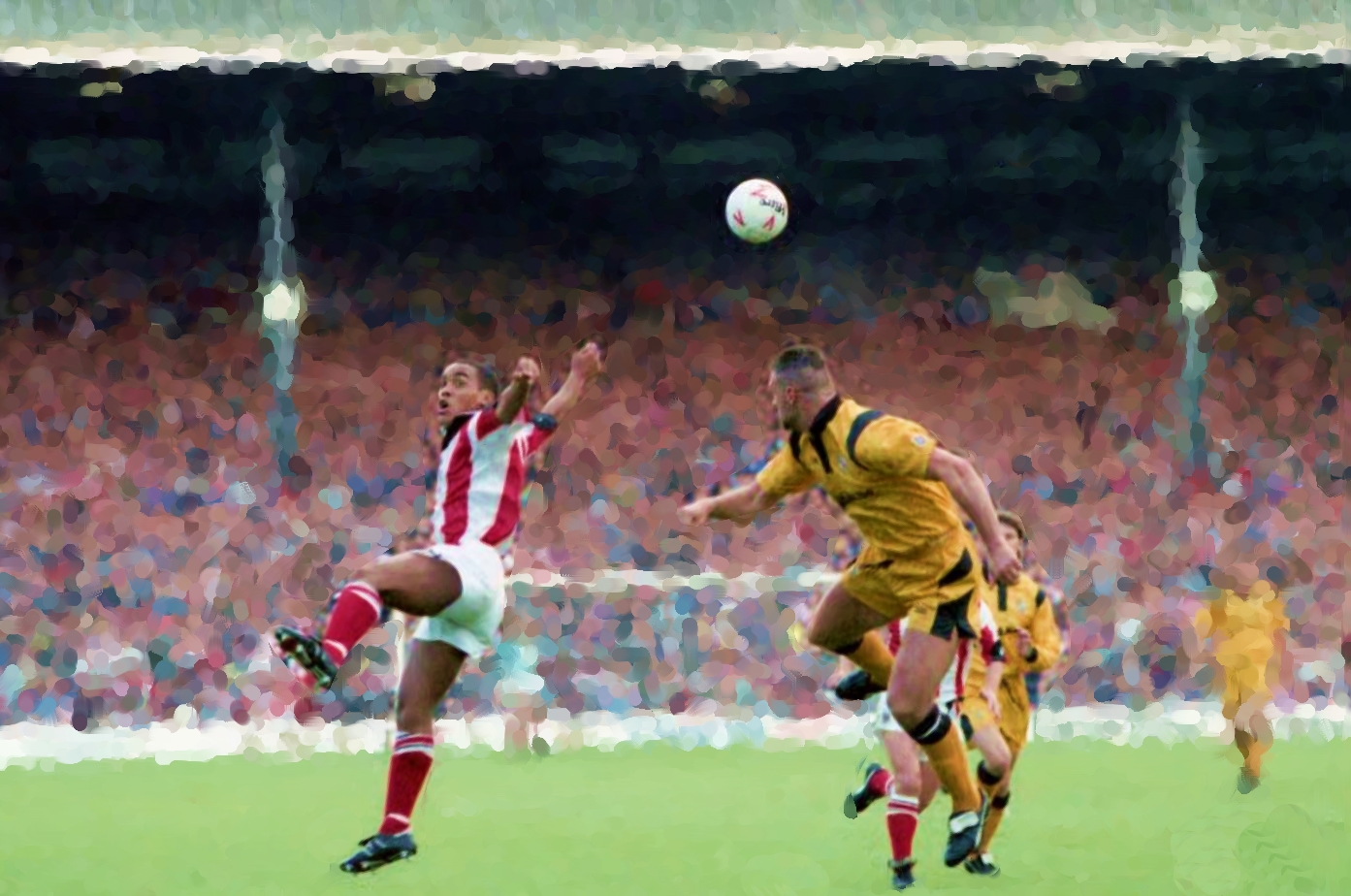
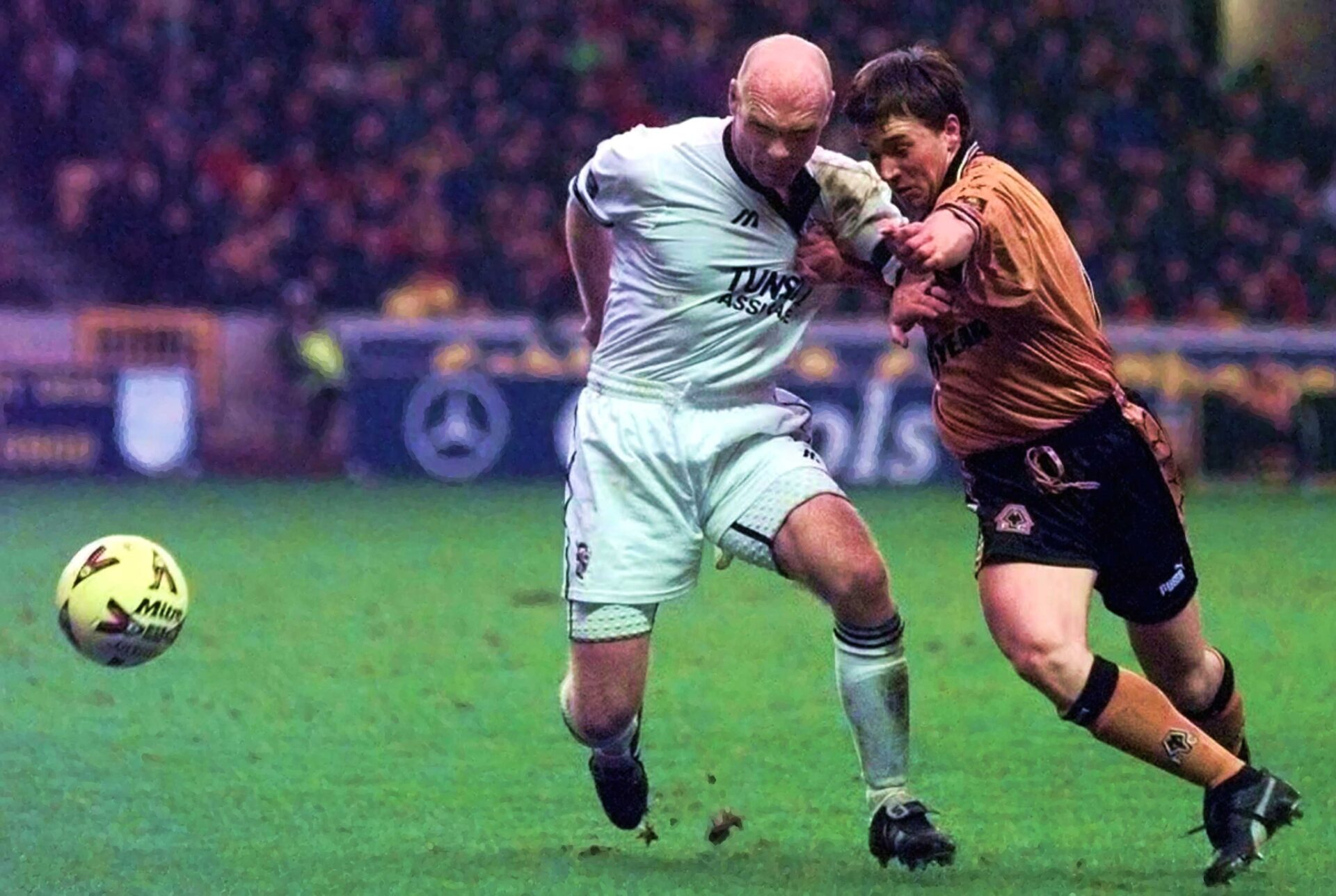
Peter Swan
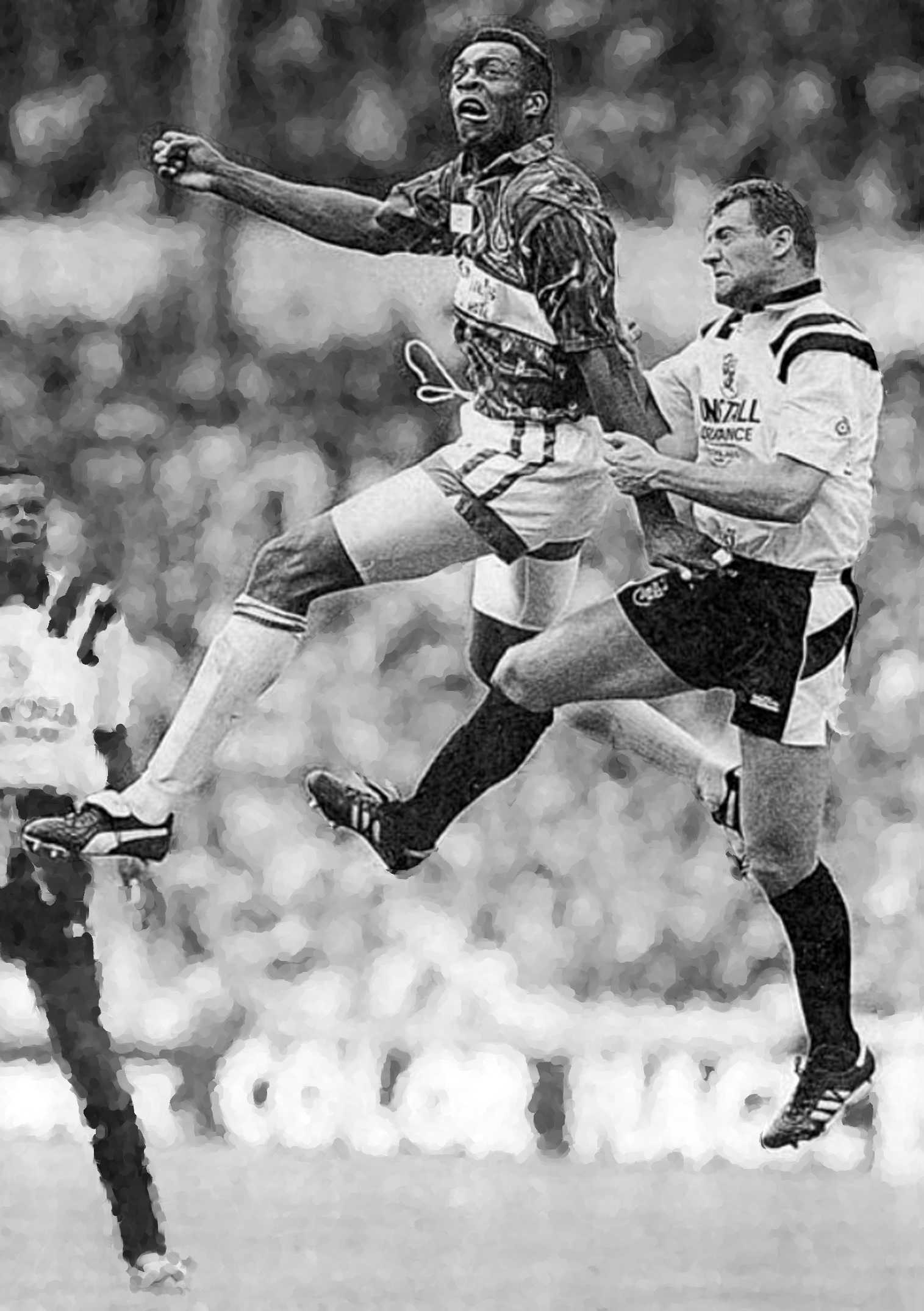
Peter Swan takes on Kevin Francis
Eddie Gray, Swan’s agent, arranged the £300,000 move to John Rudge’s Port Vale in August 1991, with a £52,500 signing on bonus for Swan in addition to his £650 a week wages and complimentary new car. Swan later revealed in his autobiography that he only passed his medical by concealing all evidence of the cruciate injury to his right knee.
Rudge played Swan almost exclusively as a defender and he never had significant problems with his knee but Rudge did have to issue many fines for the many practical jokes Swan would carry out.
After recovering from a foot injury, Rudge played Swan in attack in a Football League Cup tie with Liverpool at Anfield, and Swan set up Martin Foyle for the equalising goal – despite his ‘cross’ being a miscued shot. The foot injury then turned out to be a stress fracture, and Swan was sidelined until Christmas. At the end of the season Vale were relegated to the third tier, and Swan was sent off for dissent in the defeat to Cambridge United that confirmed the club’s relegation.
He added to his inevitable fine from the club by continuing his verbal attack on the referee after the game, and following an investigation by the FA he continued to land himself in hot water with an elaborate practical joke he played on the FA officials who came to speak to Rudge at Vale Park.
A first-team regular alongside defensive partners Neil Aspin and Dean Glover, in the summer of 1992, he helped the club win the pre-season TNT Tournament. His performances in the 1992–93 season saw him awarded a place on the PFA Second Division team. He was man of the match in the Football League Trophy final victory over Stockport County – despite suffering from a double hernia and being hung-over from a secret boozing session the night before. The season finished on a negative note though, in the second half of the 1993 Second Division play-off final against West Bromwich Albion, with the game still goalless, Swan was sent off after bringing down Bob Taylor – who was through on goal.
This proved to the turning point in the game as West Brom went on to win 3–0 to secure promotion at Vale’s expense. It also meant that he went down in history as only the third Englishman to be sent off at Wembley, after Kevin Keegan and Lee Dixon.
Sidelined for a period, recovering from a hernia operation, Swan spent much of the 1993–94 pre-season making visits to the local children’s hospital as he was moved by the patients he met there, particularly by a small girl called Lisa who died later that summer. Once he made it back onto the training field, he had a small fight with teammate Bernie Slaven.
I think this took place before a match at York City. I remember arriving at Bootham Crescent early and entering the ground more than an hour before kick-off only to find Bernie and Peter out on the pitch passing a ball between themselves. The rumour amongst the Vale fans present was that the pair had come to blows in the dressing room. As Rudge built a solid team, the club earned automatic promotion, with Swan being a vital contributor to this success.
However, by October, Swan fancied a new club and challenge and handed in a transfer request. In July 1994 he was sold on to Peter Shilton’s Plymouth Argyle for a fee of £300,000, then a Plymouth record.
The 1991–92 season was Port Vale’s 80th season of football in the English Football League, and third successive season in the Second Division. Under manager John Rudge and chairman Bill Bell, the club endured a dismal campaign and finished bottom of the table with 45 points, falling five points short of safety and suffering relegation. The reliable goalkeeper Mark Grew earned the Player of the Year award for his consistently solid performances between the posts. Cup runs offered little solace: in the FA Cup, Vale bowed out in the Third Round, eliminated by Sunderland; in the League Cup, they earned a memorable 2–2 draw at Anfield with Liverpool, only to suffer defeat in the replay.
Read all the episodes
- 75 years a Vale fan: part one of Stuart Dean’s Port Vale memoirs
- 75 years a Vale fan: part two of Stuart Dean’s Port Vale memoirs
- 75 years a Vale fan: part three of Stuart Dean’s Port Vale memoirs
- 75 years a Vale fan: part four of Stuart Dean’s Port Vale memoirs
- 75 years a Vale fan: part five of Stuart Dean’s Port Vale memoirs
Share your thoughts on these memories and post a comment below
Add your first comment to this post